

Risk Management · 2025
In this section5 topics
Risk Management Policy & Plan
Policy & Plan Description
Due to the complexity and a rapidly changing business environment currently, these are the major causes risks to business operations and may affect the ability to achieve the short-term, mid-term, and long-term goals to drive the organization for sustainable successes. The Company therefore recognizes the importance of risk management, both from internal and external factors, for efficient management and highest effectiveness.
The Company therefore applied risk management principles in accordance with the international standards ISO 31000:2018 and COSO ERM:2017, with the aim of making employees and stakeholders aware of the importance of risk management and help the organization to see both positive opportunities and negative impacts related to various risks, as well as helping to realize resource allocation and decision-making in various operations more effectively.
Risk Governance Structure
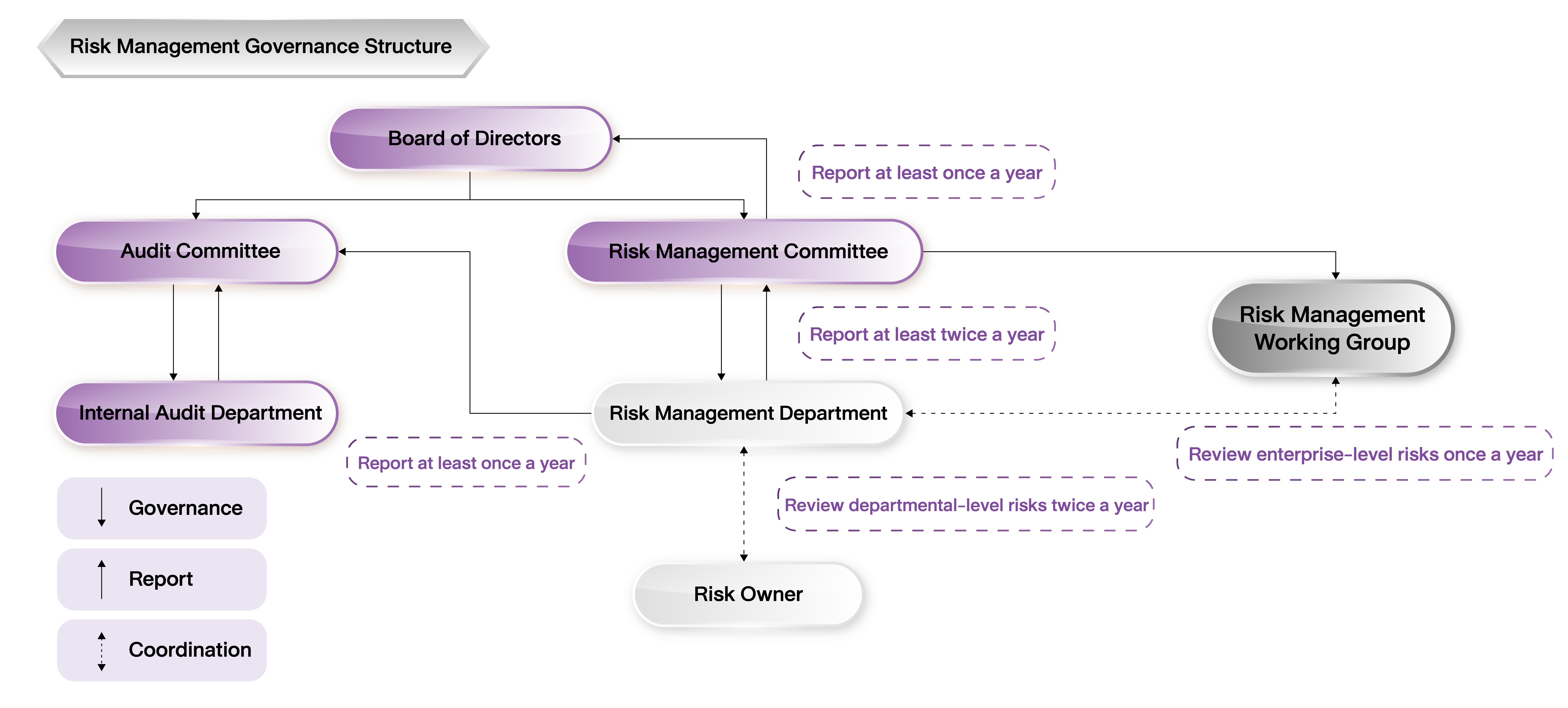
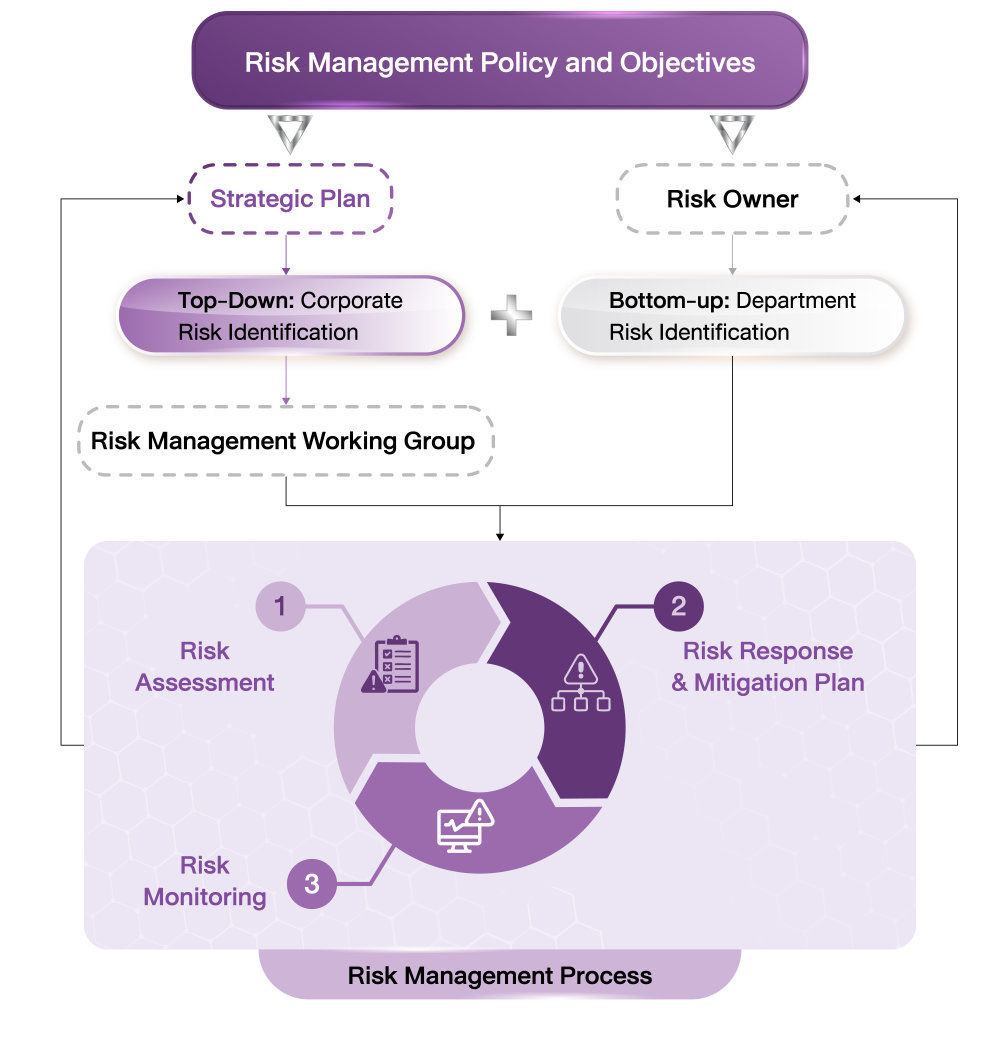
To ensure that the organization could effectively identify, assess, manage and monitor risks that might affect the achievement of its goals, the Company established the Risk Governance Structure as part of the enterprise-wide risk management system. The Board of Directors has appointed the Risk Management Committee to consider and determine risk management policies, as well as supervise and support risk management to achieve business goals as planned. In addition, the Company has set up the Enterprise Risk Management Working Group, which is responsible for analyzing and assessing enterprise-level risks, including overseeing and monitoring risk management at the department level, so that the Company has risk management throughout the organization from Top-Down, under the policy framework to be consistent with the Company’s vision, strategies and business impacts, and and Bottom-Up that reflects operational-level risk management, and also links with the objectives of enterprise-level risk management in the same direction.
Risk Management Policy
The Company developed the Risk Management Policy to set the direction and support the risk management in accordance with the Company’s strategies and objectives This policy also encourages all levels of executives and employees to adhere to and implement the same approach. More details are available on the Company’s website.
https://www.sritranggloves.com/en/corporate-info/corporate-governance/corporate-policy. The risk management process is shown in the diagram below.
Risk Management Culture
The Company integrates risk management into its organizational operations through the establishment of clearly defined Risk Owners for each key risk area. This approach ensures that risk management is aligned with corporate policies, core values, strategic plans, and relevant departmental Key Performance Indicators (KPIs), thereby promoting effective and practical implementation of risk mitigation measures. The Company also encourages executives and employees at all levels to remain aware of potential risks and to prioritize risk management. This is accomplished through various communication channels, such as departmental risk assessments, e-learning training programs, and internal awareness campaigns via the Company’s website. In addition, the Company conducts regular monitoring and assessment of risks, and uses the evaluation results to support strategic decision-making, ensuring that risk management activities align with organizational objectives and contribute to long-term sustainable growth. To maintain a continuous and robust risk management framework, the Company requires regular reporting of risk management outcomes to relevant Sub-committees to assess the adequacy of the Company’s risk management measures, as follows:
- The Board of Directors meeting
Risk Management Department reports to the Board of Directors at least once a year for the result of risk management in the significant risk management issues.
- Risk Management Committee meeting
Risk Management Department reports to the Risk Management Committee at least twice a year for the result of enterprise risk management.
- Audit Committee meeting
Risk Management Department reports the results of risk management and holds joint meetings with the Audit Committee at least once a year to be beneficial in preparing the audit plan and internal control to cover and be consistent with the Company's significant risks, as well as reflects the consistency of internal controls that may affect the assessment and prioritization of the Company’s enterprise risks.
Risk Factors — Overview
Risk Factors — Introduction
The Company has analyzed the business environment both inside and outside the organization, including trends in the economy, society, environment, technology, industry, competitors, and other related matters to determine important risk factors for the Company's business operations, both the existing risks and new risks that may occur in the future, including environmental, social, governance and economic (ESG) risks. In order for the Company to have measures to manage risks in all aspects that affect business operations and result in the Company having sustainable business operations. Accordingly, the Company has prioritized its key risks as follows:
Risk Prioritization
1. Risk from the climate change strategy
2. Risk from intense competition with major manufacturers and distributors of similar products.
3. Cybersecurity and data privacy risk
4. Risk from production and business disruption
5. Risk from dependence on key suppliers for concentrated latex, synthetic latex, raw materials, and other services provided to the Company
6. Risk from failing to deliver products to customers as scheduled
7. Product quality and safety non-compliance risk
8. Geopolitical risk (Emerging risk)
9. Risk from foreign exchange volatility
10. Risk from managing and developing employee skills
11. Risk from selling prices not reflecting volatile production costs
12. Risk from adopting sustainable artificial intelligence in the Company
13. Risk from technology changes and advancements (Emerging risk)
14. Risk from non-compliance with requirements and regulations of relevant regulatory or governmental authorities
15. Corruption Risk
Risks to the Company's Business Operations
Risk Register
| Risk Name | Risk Characteristics | Consequences | Management Measures | Related Risk Factors |
|---|---|---|---|---|
| Risk from the climate change strategy | Characteristics and Causes of Risks The Company is affected by climate change and increasingly stringent regulations, including international trade requirements, the draft Climate Change Act, the SET guidelines, and customer demands for greenhouse gas disclosure and reduction aligned with agreed targets. These factors increase operating costs and require greater investment in low-carbon technologies. Without effective and adequate plans to address climate-related impacts, the Company may face business disruptions, reduced competitiveness, and a decline in stakeholder confidence in the long term. Climate-related impacts on business operations and production processes may also increase greenhouse gas emissions. Moreover, the absence of a clear climate-risk strategy could heighten the risk of operational interruptions and further undermine long-term stakeholder trust. | 1. Business Continuity and Supply Chain
2. Trust and Business Partnerships
3. Regulatory Compliance and Financial Costs
| 1. Establishment of Business Continuity Plan (BCP)
2. Enhancing Standards and Regulatory Compliance
3. Data Management and Innovation
4. Energy and Infrastructure Management
| 736 · Description: Damage to company image and reputation · Info category: STRATEGIC_RISK · 750 · Description: Climate change and disasters · Info category: OPERATIONAL_RISK · 1717 · Description: ESG risk · Info category: STRATEGIC_RISK · 1719 · Description: Climate change and disasters · Info category: STRATEGIC_RISK · 737 · Other name: Emerging Risk · Description: Other · Info category: STRATEGIC_RISK |
| Risk from intense competition with major manufacturers and distributors of similar products. | Characteristics and Causes of Risks The Company is currently facing competition from major manufacturers and distributors within the region, as well as intense competition in export markets. If competitors are able to manage their production costs more effectively, they may gain an advantage in pricing. In addition, further increases in production capacity from new entrants or existing competitors may intensify price pressure on rubber gloves, which are the Company’s core products. Should competitors achieve sufficiently high export volumes to influence market prices, the competitive landscape would further intensify. These factors may adversely and significantly affect the Company’s profitability and financial position. |
|
| 728 · Description: Volatility in the industry in which the company operates · Info category: STRATEGIC_RISK · 1714 · Description: Competition risk · Info category: STRATEGIC_RISK |
| Cybersecurity and data privacy risk | Characteristics and Causes of Risks The Company actively promotes the adoption of new technologies, including artificial intelligence (AI), in both production and business management, including manufacturing, inventory management, research and development, as well as accounting and finance. These technologies enhance efficiency, accelerate operational processes, reduce errors, and help expand sales channels to strengthen business competitiveness. However, the adoption of new information technologies may introduce risks related to IT system management, cyber threats, and information security. Such risks could result in system disruptions, operational interruptions, potential legal disputes, and adverse impacts on the Company’s reputation. |
| The Company continues to invest in upgrading its business systems to keep pace with technological advancements and to support future innovations. Cybersecurity risk mitigation measures include the following: 1. Enhancing network infrastructure to ensure system availability and prevent failures in network and server operations. 2. Implementing control measures, such as computer security systems, disaster recovery planning, engaging external specialists to conduct vulnerability assessments and penetration tests, and establishing data governance frameworks for AI and IOT technologies. 3. Maintaining a backup data center to support emergency situations. 4. Reviewing emergency response plans and conducting drills in accordance with the Business Continuity Management system. 5. Providing IT Security, Cybersecurity Awareness, and PDPA trainings for all employees at least once a year to strengthen cybersecurity awareness and compliance with data protection laws. | 744 · Description: Information security and cyber-attack · Info category: OPERATIONAL_RISK · 1717 · Description: ESG risk · Info category: STRATEGIC_RISK · 1720 · Description: System disruption risk · Info category: OPERATIONAL_RISK |
| Risk from production and business disruption | Characteristics and Causes of Risks Natural disasters have become increasingly severe as a result of climate change, leading to floods, storms, and earthquakes that may significantly affect the Company’s business operations. If the Company is not adequately prepared to handle emergencies and maintain business continuity, these events may adversely impact its image, reputation, and overall performance. In addition, disruptions to production and business operations may also arise from internal incidents, such as boiler explosions, fires, or information technology failures. These events can cause damage to assets, undermine stakeholder confidence, and may significantly reduce the Company’s profitability. | 1. Production processes may be disrupted by natural disasters such as floods, storms, and earthquakes, as well as internal incidents including fires, boiler explosions, and IT failures. 2. Costs may increase due to recovery procedures required to resume production, and revenue may decline as a result of production downtime. 3. Impact on the environment and the communities surrounding the factories. 4. Negative impacts on the Company’s reputation and image. | 1. Insurance policies are in place to cover various crisis events such as floods and fires. 2. Business Continuity Plan (BCP) has been established to address situations such as floods, fires, boiler explosions, and IT system failures, and BCP drills are conducted on an annual basis. 3. Emergency contact numbers for coordination with external agencies are reviewed annually to ensure timely support for the Company and employees in the event of an emergency. | 736 · Description: Damage to company image and reputation · Info category: STRATEGIC_RISK · 750 · Description: Climate change and disasters · Info category: OPERATIONAL_RISK · 1717 · Description: ESG risk · Info category: STRATEGIC_RISK · 1719 · Description: Climate change and disasters · Info category: STRATEGIC_RISK |
| Risk from dependence on key suppliers for concentrated latex, synthetic latex, raw materials, and other services provided to the Company | Characteristics and Causes of Risks The Company sources most of its concentrated latex from the STA Group as the main raw material for the production of natural rubber gloves, while synthetic latex is procured from the Company’s external suppliers. In addition, several key services essential to the production process are provided by major business partners under the same major shareholder (STA), as follows:
If any of these major business partners are unable to supply raw materials or provide services as planned, the Company’s business operations may be significantly affected. |
|
| 735 · Description: Reliance on large partners / distributors or few partners / distributors · Info category: STRATEGIC_RISK |
| Risk from failures to deliver products to customers as scheduled | Characteristics and Causes of Risks The current fluctuations in product demand, which change continuously, may cause production planning to deviate from expectations. This may result in product deliveries not meeting the planned schedule and may affect customer satisfaction, confidence in the Company, and the Company’s reputation. | 1. Impacts on the Company’s reputation and customer satisfaction from failures to meet the committed delivery schedule. 2. Increased operating costs resulting from penalty charges under contracts that specify delivery deadlines, as well as from offering additional discounts to customers. | 1. Communicating and negotiating with customers immediately upon identifying a potential delivery delay, including discussing contractual terms and penalties to minimize impacts and maintain customer confidence. 2. Consider switching orders with other customers, as appropriate, taking into account contractual implications and urgency. 3. Selecting reliable suppliers and service providers with strong track records in on-time delivery and raw material quality to reduce the likelihood of supplier delays. 4. Controlling quality and specifications throughout the production and packing processes to minimize rework or rejection that may delay shipment plans, and implementing regular maintenance of production lines to reduce downtime that could affect timely delivery to customers. 5. Planning and booking vessel space at least three weeks in advance to reduce risks associated with vessel space shortages and fluctuations in sailing schedules. | 736 · Description: Damage to company image and reputation · Info category: STRATEGIC_RISK · 755 · Other name: Customer satisfaction · Description: Other · Info category: OPERATIONAL_RISK |
| Product quality and safety non-compliance risk | Characteristics and Causes of Risks As the Company mainly manufactures products for medical use, the quality and safety of its products are essential factors that support the Company’s sustainable growth. If the products do not meet the required specifications, this may result in higher operating costs and may directly affect customer satisfaction, as well as the Company’s reputation. | 1. Customer satisfaction and confidence may be affected, together with the Company’s reputation, which may result in a loss of sales or revenue. 2. Compensation paid to customers may increase expenses and operating costs, thereby impacting the Company’s profitability. | 1. Establishing clear quality control procedures and conducting inspection, control, and management of product quality before delivery to customers. If any quality issue arises during production, the Company promptly investigates the cause, takes corrective action, and communicates the actions taken to prevent recurrence. 2. When improvements to work processes or quality control procedures involving suppliers or machinery manufacturers are required, the Company coordinates and closely monitors progress to ensure timely achievement of targets. 3. Setting quality control targets and customer complaint handling targets for relevant departments and continuously monitoring performance to ensure alignment with established objectives. 4. Implementing a strategy to maintain longer production runs for the same product type to enhance product stability and consistency. | 741 · Description: Systems or internal control system · Info category: OPERATIONAL_RISK · 1717 · Description: ESG risk · Info category: STRATEGIC_RISK |
| Geopolitical risk (Emerging risk) | Characteristics and Causes of Risks Geopolitical tensions have continued to escalate from past to present, driven by conflicts related to religion, ethnicity, economics, and historical disputes. Such conflicts may lead to international wars, including both armed conflict and trade wars, and could adversely affect the Company’s exports, sales, revenue, production costs, and logistics operations. | 1. If an international war or religious conflict occurs along the Company’s transportation routes, the Company may be unable to deliver products or may face delivery delays. 2. If a trade war occurs, the Company may experience impacts on its export capability to the affected country, including restrictions on export volume, higher tariffs, trade barriers, or a loss of competitiveness. These impacts may affect the Company’s revenue, market share, and costs. | 1. Diversify the customer base across different geographic regions to reduce dependence on any particular customer group. 2. Maintain flexibility in adjusting strategic plans and transportation routes in response to changing circumstances. 3. Exploring opportunities to diversify production bases and distribution channels into new countries to reduce risks from concentration in specific production or distribution locations. 4. Diversifying sources of raw materials across different regions to enhance supply resilience. | 1725 · Description: Income volatility · Info category: FINANCIAL_RISK · 1714 · Description: Competition risk · Info category: STRATEGIC_RISK |
| Risk from foreign exchange volatility | Characteristics and Causes of Risks The Company mainly sell its products in overseas markets, with sales prices mainly denominated in US dollars (USD) and Chinese yuan (CNY). As a result, most of the Company’s revenue is referenced to or received in USD and CNY, while significant costs and expenses such as concentrated latex costs, personnel expenses, and other domestic production costs are primarily denominated in Thai Baht (THB). In addition, the subsidiaries sell products in various countries using the local currencies, such as the Vietnamese Dong, Indonesian Rupiah, and Philippine Peso. Some subsidiaries also enter into loan agreements with foreign financial institutions in U.S. Dollars. Consequently, fluctuations in exchange rates between THB, USD, CNY, or other foreign currencies may affect the Company’s cash flows, financial position, operating results, and business opportunities. Exchange rate volatility may also impact the price competitiveness of the Company and its subsidiaries when compared with other glove manufacturers and distributors in Malaysia, the People’s Republic of China, and Indonesia. | 1. Higher operating costs. 2. Lower revenue, liquidity, and cash flows from overseas sales in the event of Thai Baht appreciation. 3. Higher costs from the import of raw materials such as NBR and chemicals, as well as increased foreign currency denominated debt obligations in the event of Thai Baht depreciation. 4. The Company may experience foreign exchange losses, even with the use of financial hedging instruments, due to sharp and sudden fluctuations in exchange rates. | 1. Using FX Forward contracts and Options as financial instruments to hedge risks from product sales. 2. Provide customers with a variety of foreign currency options for purchasing products in five currencies: USD, Euro, SGD, RMB, and JPY. 3. Implementing a system for monitoring market exchange rates against hedged rates on a continuous basis to enable the selection of appropriate risk management measures in response to changing circumstances. 4. Reducing the proportion of foreign currency denominated trade receivables to reduce the risk of exchange rate volatility. 6. Adjusting certain portions of revenues and expenses to the same currency (Natural Hedge). | 764 · Description: Fluctuation in exchange rates, interest rates, or the inflation rate · Info category: FINANCIAL_RISK |
| Risk from managing and developing employee skills | Characteristics and Causes of Risks The Company promotes and supports continuous employee development in term of welfare, the working environment, and opportunities for career growth, in order to enhance employee capabilities and retain talented personnel within the organization. However, if employee care measures are insufficient, inappropriate, outdated, or if skill development is misaligned with the nature of the business, this may lead to higher turnover, particularly among high-potential employees. Such circumstances could reduce operational efficiency, increase human resource costs due to recruitment and training of replacements, and ultimately affect the Company’s competitiveness and long-term sustainability. | 1. Increased employee turnover, particularly among high potential personnel. 2. Reduced work efficiency, lower or stagnant productivity, and potential interruptions in work processes. 3. Higher human resource costs due to recruitment and training of replacement staff. 4. Decreased long-term organizational competitiveness. | 1. Providing training courses and implementing continuous employee skill development plans. 2. Allocating appropriate budgets for employee training and skill development in line with current situation. 3. Conducting employee satisfaction surveys and using employee feedback to adjust benefits and welfare to better reflect current circumstances and the Company’s business needs. | 1714 · Description: Competition risk · Info category: STRATEGIC_RISK · 1717 · Description: ESG risk · Info category: STRATEGIC_RISK |
| Risk from selling prices not reflecting volatile production costs | Characteristics and Causes of Risks The Company uses key raw materials in the production of both powdered and powder-free natural rubber gloves, as well as nitrile gloves, including natural latex and synthetic latex. Accordingly, if the Company is unable to price its products in line with changes in major production costs, its profitability and financial position may be affected. | 1. Competitive disadvantage due to increased production costs. 2. The Company’s profit may decline and fall short of expectations. | 1. Managing the procurement of key raw materials in line with prevailing market prices. 2. Adjusting monthly selling prices to reflect fluctuations in key raw material prices. 3. Setting appropriate and flexible sales strategies between spot sales and long-term contracts based on market conditions. 4. Establishing a working team to manage risks related to raw material price monitoring in line with the situation. Setting timelines for price agreements and product delivery that align with inventory and production cycles to ensure selling prices reflect production costs as accurately as possible. | 728 · Description: Volatility in the industry in which the company operates · Info category: STRATEGIC_RISK · 740 · Description: Shortage or fluctuation in pricing of raw materials or productive resources · Info category: OPERATIONAL_RISK · 1725 · Description: Income volatility · Info category: FINANCIAL_RISK · 1714 · Description: Competition risk · Info category: STRATEGIC_RISK · 1715 · Description: Economic risk · Info category: STRATEGIC_RISK |
| Risk from adopting sustainable artificial intelligence in the Company | Characteristics and Causes of Risks The Company has adopted Sustainable Artificial Intelligence technologies to enhance operational efficiency, reduce operating costs, and improve the quality of its products and services. However, in the absence of an appropriate governance framework, adequate risk assessments, and sufficient workforce upskilling aligned with the utilization of such technologies, the Company may be exposed to legal risks, increased operational costs, reputational impacts, and a potential deterioration of its long-term competitiveness. | 1. Impact on the Accuracy of Business Decisions Inaccurate data or AI models may result in erroneous outputs, leading to misinformed strategic decisions. 2. Increased Operating Costs Additional expenses may arise from the correction, enhancement, or remediation of AI systems to ensure effective performance and compliance with applicable requirements. 3. Reputational and Stakeholder Confidence Risks Errors or inappropriate use of AI may undermine the Company’s credibility and adversely affect the trust of customers, business partners, investors, and regulatory authorities. 4. Employee Concerns Regarding Job Roles and Employment Security Introducing AI without adequate communication or appropriate upskilling initiatives may cause employees to feel uncertain about their job security. 5. Suboptimal Utilization of Technology Post-Implementation Delays or performance shortfalls may occur if AI systems are not sufficiently mature or if personnel lack the necessary expertise to operate them effectively. | 1. Establish and enforce a Data Governance Framework 2. Provide AI training for employees 3. AI Project Prioritization 4. AI Foundation Improvement 5. Develop an AI Solution Governance Framework | 732 · Description: Changes in technologies · Info category: STRATEGIC_RISK · 746 · Description: Delays in the development of future projects · Info category: OPERATIONAL_RISK · 1714 · Description: Competition risk · Info category: STRATEGIC_RISK · 1717 · Description: ESG risk · Info category: STRATEGIC_RISK |
| Risk from technology changes and advancements (Emerging Risk) | Characteristics and Causes of Risks The introduction of new technologies, or the transition toward technology-driven systems in production and related processes, may affect the Company’s existing workforce structure and could impact product quality if such changes are not properly managed. In addition, modern technologies such as online transactions, the use of artificial intelligence (AI) for market data analysis, and the expansion of sales channels through e-commerce may require adjustments to work procedures and related support functions. These developments may therefore have a significant impact on the Company’s competitiveness and its readiness to adapt to future changes. | 1. If the Company is unable to adapt to technological changes, its competitiveness may be affected as operating costs could become higher than those of competitors. 2. Revenue and market share may decline. 3. The Company’s credibility may deteriorate if it fails to adapt in a timely manner. 4. The Company may be unable to meet evolving consumer demands. | 1. Studying and developing the adoption of automation in work processes continuously to enhance competitiveness. 2. Establish an Artificial Intelligence (AI) team to monitor, update, and assess the severity of potential impacts from new technologies that could affect the Company if not applied in its work processes. 3. Develop policies related to the adoption of new technologies, such as an AI Governance Policy. | 729 · Description: Behavior or needs of customers / consumers · Info category: STRATEGIC_RISK · 732 · Description: Changes in technologies · Info category: STRATEGIC_RISK · 1714 · Description: Competition risk · Info category: STRATEGIC_RISK |
| Risk from non-compliance with requirements and regulations of relevant regulatory or governmental authorities | Characteristics and Causes of Risks For domestic operations, the Company and its subsidiaries are subject to supervision by various government authorities responsible for licenses and permits required for business operations, such as the Department of Industrial Works, Ministry of Industry, Ministry of Natural Resources and Environment, Ministry of Public Health, the Food and Drug Administration, and the SET. Failure to fully comply with the conditions of these licenses may result in suspension, revocation, non-renewal, or penalties, whether civil or criminal, and may also impact the safety of assets and personnel. Such consequences could adversely affect the Company’s operations, image, and reputation. For overseas operations, business activities related to the sale of products abroad are regulated by government authorities in each respective country. Failure to comply with foreign trade and investment regulations or the conditions of required licenses may result in suspension, revocation, non-renewal, or legal penalties, whether civil or criminal, and may adversely affect the Company’s operations, image, and reputation in international markets. Remark 1. Factory Act B.E. 2535 (1992) 2. Groundwater Act B.E. 2520 (1977) 3. Occupational Safety, Health, and Working Environment Act B.E. 2554 (2011) 4. Labour Protection Act B.E. 2541 (1998) 5. Ministerial Regulation on Safety Standards for Machinery, Cranes, and Boilers B.E. 2552 (2009) 6. Ministerial Regulation on Safety Standards for Hazardous Chemicals B.E. 2556 (2013) 7. Securities and Exchange Act Moreover, various certifications and licenses have specific validity periods that require timely renewal to maintain continuity. Failure to renew on time may result in expiration, which could negatively impact the Company’s operations. Examples include ISO 13485 and ISO 9001, and other relevant certifications or regulatory licenses. If such certifications expire due to untimely renewal or negligence, the Company may face operational, commercial, or reputational impacts. If product development fails to meet applicable standards or regulatory requirements, such as the use of prohibited raw materials or non-compliance with glove manufacturing specifications, the Company may face adverse consequences, including regulatory actions, customer rejection, or reputational harm. For international business, trade barriers may also arise, which may result in the withdrawal or modification of preferential trade privileges previously granted to the Company, such as changes in tariff rates, potentially affecting certain Company products. | 1. Impacts on Licenses and Certifications
2. Legal and Cost Implications
3. Impacts on Corporate Reputation and Stakeholder Confidence
4. Impacts on Consumers and Customer Complaints
|
| 756 · Description: Change in laws and regulations · Info category: COMPLIANCE_RISK · 730 · Description: Government policy · Info category: STRATEGIC_RISK · 758 · Description: Violations of laws and regulations · Info category: COMPLIANCE_RISK · 731 · Description: Policies or international agreements related to business operations · Info category: STRATEGIC_RISK · 741 · Description: Systems or internal control system · Info category: OPERATIONAL_RISK · 759 · Description: Corporate Governance · Info category: COMPLIANCE_RISK · 742 · Description: Human error in business operations · Info category: OPERATIONAL_RISK · 736 · Description: Damage to company image and reputation · Info category: STRATEGIC_RISK |
| Corruption Risk | Characteristics and Causes of Risks In the course of various work processes, there may be opportunities or channels that allow personnel to neglect their duties or misuse their authority in order to obtain undue benefits for the organization, for themselves, or for related parties. Should such incidents occur, they could affect the Company’s credibility, image, and reputation, and may also impact the Company’s business dealings with its partners. Therefore, the Company recognizes the importance of good corporate governance and the prevention of corruption in all stages of its operations. The Company has established a clear governance structure and well-defined roles and responsibilities, from the management level down to operational staff, to ensure that all business activities are conducted with transparency and are subject to proper oversight. | 1. The occurrence of fraud or corruption may reduce the Company’s competitiveness, lead to the loss of business opportunities, and cause both direct and indirect financial damage. 2. Instances of behavior that violate principles of good corporate governance may weaken the organization’s ethical standards and undermine its commitment to maintaining transparency. 3. Corruption risks may erode the confidence of customers, business partners, investors, and regulatory authorities in the Company’s internal controls and overall operations. 4. Failure to comply with laws or regulations related to anti-corruption may result in fines, damages, or legal action, all of which could affect the Company’s financial position. | 1. The Company has joined the Thai Private Sector Collective Action Against Corruption (CAC) to demonstrate its commitment to anti-corruption and to adopt appropriate practices within the organization. 2. Established a clear governance structure with defined roles and responsibilities to prevent misconduct and ensure proper checks and balances, supported by charters that specify the duties and responsibilities of each committee. 3. Implemented anti-corruption policies and communicated them to employees at all levels through annual e-learning programs to reinforce awareness of transparent and ethical practices. 4. Conducts a review of all anti-corruption policies on an annual basis. 5. Defines clear investigation procedures and disciplinary actions in cases where fraudulent behavior by employees is identified. 6. Maintains a Code of Conduct to guide directors, executives, and employees in upholding transparency and accountability. 7. Provides channels for receiving complaints, enabling stakeholders to report suspected corruption, with whistleblowers protected under the Whistleblowing policy. 8. Executes declarations of intent with business partners regarding anti-bribery, with measures such as blacklisting, contract termination, and legal action applied in case of violations. 9. Establishing a robust internal control and audit system to prevent irregularities and strengthen employee work verification processes. | 741 · Description: Systems or internal control system · Info category: OPERATIONAL_RISK · 742 · Description: Human error in business operations · Info category: OPERATIONAL_RISK · 1717 · Description: ESG risk · Info category: STRATEGIC_RISK · 754 · Description: Corruption · Info category: OPERATIONAL_RISK |
Risks to Securities Holders' Investment
Risk Register
| Risk Name | Risk Characteristics | Consequences | Management Measures | Related Risk Factors |
|---|---|---|---|---|
| Risk from dividend payment for shareholders held the Company's shares on the SGX-ST | Characteristics and Causes of Risks Shares of the Company traded on the SGX-ST are denominated in Singapore dollars, while dividend payments (if any) are paid in Thai baht. As a result, shareholders holding the Company’s shares on SGX-ST are exposed to exchange rate risk from fluctuations between the Singapore dollar and the Thai baht. | Dividend payments to shareholders may be lower than expected due to fluctuations in exchange rates. | Using the Singapore dollar to Thai baht exchange rate closest to the dividend payment date helps reduce shareholders’ exposure to exchange rate fluctuations. | 768 · Description: Return from investment of securities holder · Info category: HOLDER_RISK |
| Risk from the Company having a major shareholder whose holding is more than 50 percent | Characteristics and Causes of Risks As of December 30, 2025, Sri Trang Agro-Industry Public Company Limited and its subsidiaries collectively held 1,605,401,400 shares of the Company, representing 56.03 percent of the Company’s total issued and paid-up shares. This shareholding structure enables the Sri Trang Agro-Industry Group to control shareholders’ meeting resolutions on matters requiring a simple majority vote, such as the appointment of directors or any other agenda that requires approval by a majority of the shareholders present and entitled to vote, except for matters that, by law or the Company’s Articles of Association, require at least three-fourths of the votes at the shareholders’ meeting. As a result, minority shareholders may be unable to obtain sufficient votes to scrutinize or counterbalance resolutions proposed by the major shareholder. | Other shareholders may be unable to consolidate sufficient votes to review and counterbalance the matters proposed by the major shareholder. | The Company recognizes such risks and has therefore established the Corporate Governance Policy which the Board of Directors and the Management are required to observe, with due regard to shareholders’ rights and accurate, transparent, and equitable disclosure of information. In addition, the Company has an Internal Audit function under the supervision of the Audit Committee, as well as an External Audit, to provide oversight, checks, and balances with respect to decision-making and the approval of various transactions. The Company also maintains a Risk Management Department under the supervision of the Risk Management Committee to ensure that the Company’s risks are managed within an acceptable level. Furthermore, the Company has appointed the Nomination Committee and the Remuneration Committee to safeguard the interests of all stakeholders in a fair and transparent manner. | 768 · Description: Return from investment of securities holder · Info category: HOLDER_RISK · 2969 · Description: Risk of the company having a majority shareholder holding > 50% of shares · Info category: HOLDER_RISK |
Foreign Investment Risk
Risk Register
| Risk Name | Risk Characteristics | Consequences | Management Measures | Related Risk Factors |
|---|---|---|---|---|
| Risks of investing in foreign securities | Characteristics and Causes of Risks The Company manages its funds by investing in various financial assets to generate additional income for the Group Company. These investments are undertaken by Sri Trang Gloves Global Pte. Ltd., a wholly owned subsidiary incorporated in Singapore, which oversees the Group Company’s financial asset and investment management. Investment activities are carried out prudently, with primary consideration given to achieving the highest possible returns. However, the performance of these investments depends on several external factors beyond the Company’s control, including interest rates, exchange rates, and the returns of the invested assets. Due to the long-term investment policy, certain periods may yield gains or losses that differ from expectations. As a result, the Company may face risks of capital loss and may not receive the anticipated returns during some periods. | The Company may be exposed to capital losses and may not receive the expected returns during certain periods. | The Company diversifies its investments across a wide range of financial assets, including bank deposits, debt securities, equity instruments, derivatives, investment units, and offshore funds. External advisors are also engaged to support asset management and ensure that investment portfolios are appropriately managed and diversified under all market conditions. | 770 · Description: Foreign Investment Risk · Info category: FOREIGN_RISK |