

Board Performance · 2025
In this section14 topics
- Compliance Monitoring — Overview2 items
- Prevention of Conflicts of Interest4 items
- Prevention of the Use of Inside Information4 items
- Anti-Corruption6 items
- Whistleblowing5 items
- Selection of Directors & Chief Executives7 items
- Selection of Independent Directors2 items
- Director Development4 items
- Evaluation of Board & Subcommittee Performance4 items
- Subcommittees1 item
- Meeting Attendance & Remuneration6 items
- Supervision of Subsidiaries & Associated Companies5 items
- Audit Committee Duty Performance1 item
- Executive Committee Duty Performance1 item
Compliance Monitoring — Overview
Compliance Monitoring — Introduction
In overseeing and monitoring the Company’s compliance with the corporate governance policy and code of conduct in 2025, it does not appear that directors, executives, and employees have committed actions that are considered to be in violation of the rules specified in any such policy and code of conduct.
Monitoring of Compliance with Other CG Policies & Guidelines
2025 Key Corporate Governance Performance in Accordance with the CGR Criteria
The Company participated in the 2025 Corporate Governance Report (CGR) assessment for listed companies, organized by the Thai Institute of Directors Association (IOD). The key corporate governance performance results can be summarized into four main areas as follows:
1. Rights and Equitable Treatment of Shareholders
The Company recognizes and places importance on the fundamental rights of shareholders, including the buying, selling, or transferring of securities, access to sufficient information of the Company and its subsidiaries, and participation and voting in shareholders’ meetings on significant corporate matters. The Board of Directors has therefore prescribed various operational guidelines to protect shareholder rights and to promote and facilitate the exercise of such rights. Additional details are presented in Section 8.1.2 regarding Meeting Attendance and Remuneration.
2. Consideration of Stakeholders’ Roles and Sustainable Business Development
The Company emphasizes the rights of all stakeholders, whether defined by law or agreement, recognizing that positive relationships and cooperation between the Company and its stakeholders are critical to supporting sustainable business growth. Additional information on the Company’s stakeholder performance is provided in the Sustainability Report available at https://www.sritranggloves.com/en/downloads/sd-report
3. Disclosure and Transparency
The Company places importance on the information required to be disclosed to the Stock Exchange of Thailand, the SEC, shareholders, and relevant authorities. In 2025, the Company disclosed essential information accurately, completely, transparently, and equally, as follows:
Disclosed financial information, acquisitions and disposals, related-party transactions, and other significant business and performance information accurately, completely, sufficiently, and in a timely manner. Financial statements were reviewed or audited by the auditor in accordance with generally accepted accounting standards and approved by the Audit Committee and the Board of Directors before being released to the SEC, the SET, shareholders, and relevant authorities.
Disclosed information through various channels, including the Company’s website, the SETLink information disclosure system of the SET, and the SEC, to ensure that shareholders and stakeholders receive the Group Company’s information comprehensively and equally.
Established a dedicated Investor Relations unit responsible for communicating and providing information to shareholders, retail investors, institutional investors, analysts, and relevant agencies.
4. Board Responsibilities
The Board of Directors is responsible to shareholders for business operations and for ensuring compliance with laws, objectives, the Company’s Articles of Association, and resolutions of shareholders’ meetings. The Board of Directors carries out their responsibilities with integrity and due care, prioritizing the best interests of the Group Company. The Board of Directors plays a critical role in setting the Company’s direction, supervising management, establishing corporate governance policies and the business code of conduct, and ensuring compliance with applicable laws and regulations for the long-term benefit of the Group Company and its shareholders.
In 2025, the Company did not have any of the following:
Any violations related to corruption or breaches of ethical conduct.
Any serious regulatory violations under the rules of the SEC or the SET.
Any resignation of non-executive directors due to corporate governance concerns.
Any negative reputational issues arising from the Board of Directors’ failure to perform its oversight duties
Prevention of Conflicts of Interest
Introduction
The Group Company has determined the Policy for the Prevention of Conflict of Interests based on the principle that the decisions of entering into any transactions must be conducted in the best interests of the Company and its shareholders. All actions with possible conflict of interests with those of the Company shall be avoided. In principle, the directors, executives and employees of the Company who are involved in or have interests in transactions being considered shall notify the Company of the nature of relationship or their interests in the transactions and shall not participate in the consideration or have any authority in the approval of the transaction.
Guidelines
(1) Directors, executives and employees of the Company shall refrain from conducting business, either directly or indirectly, having nature that is similar to and in competition with the business of the Company or its subsidiaries either for their own benefit or for others’ which may cause damage to the Company
(2) Directors, executives and employees of the Company shall disclose information about their personal business or business of their family members or relatives or dependents which may result in a conflict of interest with those of the Company or its subsidiaries.
(3) Directors, executives and employees shall not use confidential information of the Company, or its subsidiaries and they are required to strictly comply with the Inside Information Policy.
(4) Directors, executives and employees shall refrain from holding shares in the competitors of the Company or its subsidiaries to the extent where such shareholding is material or before the Company or its subsidiaries have engaged in the business, or shareholding that is acquired as an estate shall be notified to their supervisor immediately.
(5) Directors, executives and related persons shall ensure that the Company has complied with the requirements and methods of disclosure of information on related party transactions and refrain from entering into related party transactions with themselves or with related persons/ juristic persons which would cause possible conflict of interests with those of the Company. If related party transactions are not entered into on general commercial terms in accordance with the principle approved by the Board of Directors, or where the nature and size of the transaction is not within the authority of the management to approve, such transactions shall be reviewed and are subject to the opinion of the Audit Committee before they can be proposed to the Board of Directors or the general meeting of shareholders for approval. If it is necessary to enter into a related party transaction, the transaction shall be on general commercial terms in accordance with the principles approved by the Board of Directors, which shall be transparent and fair as would have been entered into with third parties taking into consideration the best interest of the Company.
(6) Directors, executives and employees shall strictly comply with the Policy for the Use of Inside Information. It is the policy of the Company to put in place an organizational structure where there is a separation of work and responsibilities among work units and employees whose duties, responsibilities or nature of would give rise to the possible conflict of interests.
(7) Directors, executives and employees shall not be involved in the consideration of transactions in which they have a conflict of interest and have to disclose their conflict of interest or report their interest in each transaction as follows:
Directors have to report their interests prior to the Board of Directors’ Meeting has considered the meeting agenda and it has to be recorded in the minutes of such Board of Directors’ Meeting in order that the directors, who have significant interests and are unable to provide an opinion independently, should abstain from considering such meeting agenda.
Directors and executives have to prepare conflict of interest report of themselves and their related persons, dividing into: (1) first reporting at the time of appointment (2) annual reporting (3) reporting in case of any changes during the year. The Company Secretary shall keep, maintain, and submit such report to the Chairman of the Board of Directors and the Chairman of the Audit Committee for further use in the verification and monitoring of conflicts of interest.
Employees in all levels have the duties to prepare a conflict of interest report in an annual basis. If they found that they or their related persons have any interests that may conflict with their performance, they have to report supervisor immediately.
Has the Company Acted to Prevent Conflicts of Interest?
Yes
Operations in the Past Year
Key Performance in 2025
The Board of Directors required monitoring of compliance with the corporate governance policy, including the Prevention of Conflict of Interests Policy, as well as communication to ensure that personnel in the organization are informed and comply.
All directors, executives, and employees strictly complied with this policy, and it was not found that there were any persons performing their duties against the Prevention of Conflict of Interests Policy.
The Board of Directors reviewed the policy on an annual basis, however, no amendment was required last year, as the Board of Directors considered that the current version remains consistent with relevant laws and regulations, the good corporate governance principles of the SEC, and international standards, and supports effective and efficient work in this area and the Company’s business operations, as well as the good corporate governance principles of the SEC and international corporate governance assessment criteria, thereby supporting effective and efficient work in this area and the Company’s business operations.
All directors and executives acknowledged and agreed that will comply with the Prevention of Conflict of Interests Policy and annually submitted a conflict of interest report to the Company Secretary to report the Chairman and Chairman of Audit Committee for acknowledgement.
Employees at all levels have reviewed and responded to the electronic conflict of interest report form on an annual basis, whereby participation of directors, executives, and employees in the said report process accounted for 100 percent.
The Company published the Prevention of Conflict of Interests policy through the Company's internal communication system (Intranet) and external communication via the Company’s website, and also provided refresher training for all directors, executives, and employees through various channels and activities, including new employee orientation, the “One Sritrang CG Day” online event, and self-learning with an assessment test of understanding, with training and testing results as follows:
- Directors completed training and testing at 100 percent
- Executives completed training and testing at 100 percent
- Employees completed training and testing at 100 percent
In addition, in order to prevent conflicts of interest, the Company has established a clear policy to take care of items that may cause conflicts of interest, whereby the process for approving connected transactions between the companies or persons who may have conflicts is specified in writing. In the event that there is a director who has a vested interest in any agenda, that director will not have the right to vote on that agenda. In terms of approval of related transactions, the responsible agency will initially evaluate said items, provide information and analysis as to whether the said transaction is reasonable, whether it would benefit of the Company and if the price is fair. They may hire external experts to give additional opinions. Then it is presented according to the prescribed procedure through the approval process. Any executives or directors who have a vested interest in said matter will not be involved in approving said transactions. In addition, the Audit Committee will jointly consider if such related transactions are necessary and at a fair price.
Number of Conflict-of-Interest Cases
| Metric | Current Year | Previous Year | Two Years Ago |
|---|---|---|---|
| Total number of cases or issues related to conflicts of interest (cases) | 0 | 0 | 0 |
Prevention of the Use of Inside Information
Introduction
The Group Company operates their business with transparency and realize the importance of the use of inside information. In order to comply with the Securities and Exchange Act, including various regulatory requirements, the Company has set policies for the use of inside information and methods to prevent directors, executives including those holding executive positions in accounting or finance who are department managers or higher or equivalent, and employees of the Company and subsidiaries from using confidential and/or inside information of the Company and subsidiaries which has not been disclosed to the public, for their personal benefit or the benefit of others, either directly or indirectly, and regardless of whether they are rewarded or not, including the use of such information for trading in the Company's securities.
Guidelines
(1) The Company educates its directors and executives regarding the obligation to prepare and disclose reports on holding and changing securities holding of (a) themselves, (b) their spouse or common law partner, (c) minor children, and (d) any juristic person that they, their spouse or common law partner and underage children hold shares in aggregate more than 30.0 percent of the total voting rights of such juristic person and such shareholding is the largest proportion in that juristic person, to the SEC under Section 59 of the Securities and Exchange Act, and related SEC notifications, as well as providing knowledge on reporting the acquisition or disposal of securities under Section 246 of the Securities and Exchange Act and the relevant Capital Market Supervisory Board announcements.
(2) The Company requires its directors and executives to prepare and submit reports on the holding and changing securities holding of (a) themselves, (b) their spouse or common law partner, (c) underage children, and (d) any juristic person which they, their spouse or common law partner and underage children hold shares in aggregate of more than 30.0 percent of the total voting rights of such juristic person, and such shareholding is the largest portion in that juristic person according to the Securities Holding and Changing of Securities Holding Report under the format specified by the SEC Office. Such a report is required to be provided to the Company Secretary every time on the same day as the date of submission of the said report to the SEC Office. The preparation and timing and method for submitting said report shall conform to the criteria specified in the Securities and Exchange Act and related SEC announcements. The company secretary will prepare a report to the Board of Directors on a quarterly basis.
(3) The Company prohibits directors, executives and related workers, including persons who are presumed to know or possess inside information under the Securities and Exchange Act who have access to inside information that has not yet been disclosed to the public and are aware that said information may affect the price or value of the securities, or may affect investors' decision to buy or sell the Company's securities, or may cause damage to investors who wish to invest in the Company's securities, from using the aforementioned information for buying, selling, offering to buy, offering for sale, or persuading others to buy, sell, offer to buy or offer to sell the Company's securities, either directly or indirectly. Such actions (in exploiting insider information), regardless of whether they were done to gain any benefits for themselves or others, or whether disclosure of such information to allow others to do so rendered benefits in return or not. Moreover, directors and executives and related employees, including their spouse or common law partner and the underage child of such person must suspend the purchase, sale, offer to purchase or offer for sale or persuade other persons to buy, sell, offer to buy or offer for sale of the Company's securities, either directly or indirectly, in the period before the release of the financial statements, annual and quarterly financial results or information about the Company's financial position and status until the Company has been able to disclose such information to the public. The Company will notify in writing to directors and executives and related workers, including others who are presumed to know or possess inside information, that trading in the Company's securities is not allowed for at least 1 month prior to public disclosure and they should wait at least 24 hours after the information is disclosed to the public to be able to proceed with the above transactions. This written notification will also prohibit the disclosure of such material information to other persons by any means.
(4) The Company requires the directors, executives and employees of the Company and its subsidiaries to keep commercial-in-confidence and/or inside information of the Company and its subsidiaries confidential, as well as the confidential information of the Company's trade partners and subsidiaries which have become known to them from their duties. Moreover, they are prohibited from taking advantage of said information in any way, even though the disclosure thereof will not cause any damage to the Company, its subsidiaries or business partners.
(5) The Company prohibits directors, executives and employees of the Company and its subsidiaries from disclosing inside information of the Company and its subsidiaries, and from using their positions in the Company and/or its subsidiaries to wrongfully exploit by any means the inside information or information that is material to the operation which has become known to them while working in the Company and/or its subsidiaries that has not been disclosed to the public, or disclose said confidential information to third parties for their own benefit or for someone else’s benefit, either directly or indirectly, regardless of whether the person receives any benefit in return or not.
(6) The Company has established a procedure for punishing personnel who fail to comply with its policy on inside information usage. If there is a violation of the use of inside information for one’s personal benefit or for the benefit of others, either directly or indirectly, and whether it will entail either direct or indirect reward or not, will be considered a disciplinary offense according to the regulations set by the Company or a legal offense punishable by law, whereby the penalty will be based on the intent of the action and the seriousness of the offense.
Has the Company Acted to Prevent the Use of Inside Information?
Yes
Operations in the Past Year
Key Performance in 2025
The Board of Directors required monitoring of compliance with the corporate governance policy, including the Policy for the Use of Inside Information, as well as communication to ensure that personnel in the organization are informed and comply.
All directors, executives, and employees strictly comply with this policy, and it was not found that there were any persons performed against the Policy for the Use of Inside Information.
The Board of Directors reviewed the policy on an annual basis; however, no amendment was required last year, as the Board of Directors considered that the current version remains consistent with relevant laws and regulations, the good corporate governance principles of the SEC, and international standards, and supports effective and efficient work in this area and the Company’s business operations, as well as the good corporate governance principles of the SEC and international corporate governance assessment criteria, thereby supporting effective and efficient work in this area and the Company’s business operations.
All directors, executives and related persons did not buy, sell, transfer, or receive transfers of their securities during the designated blackout period, and it was not found that there were no trading the Company’s shares or other securities using inside information.
All directors, executives and employees have acknowledged the compliance with the use of inside information policy, accounting for 100 percent. The Company has shared the policy through its internal communication system (Intranet) and external communication via the Company’s website, and also provided refresher training for all directors, executives, and employees through various channels and activities, including new employee orientation, the “One Sritrang CG Day” online event, and self-learning with an assessment test of understanding, with training and testing results as follows:
- Directors completed training and testing at 100 percent
- Executives completed training and testing at 100 percent
- Employees completed training and testing at 100 percent
Number of Inside-Information Cases
| Metric | Current Year | Previous Year | Two Years Ago |
|---|---|---|---|
| Total number of cases or issues related to the use of inside information to seek benefits (cases) | 0 | 0 | 0 |
Anti-Corruption
Introduction
The Group Company conducts its business with integrity by adhering to the principle of corporate social responsibility and respect for all stakeholders in accordance with the good corporate governance principles, the business code of conduct and the Company’s policies and practices toward various stakeholder groups. The Company is committed and aspires to combat all types of corruption. To ensure that the Company puts in place a policy which sets out appropriate accountability, practices and regulations of actions to be taken to prevent corruption in all business activities of the Company and to ensure that all business decisions and operations which are exposed to corruption risks are treated and implemented with prudence, the Company established this "Anti-corruption Policy" as a written guideline on clear business practices and corporate development towards sustainability. The Anti-corruption Policy shall apply to the subsidiaries, associated companies, other companies which the Company has the controlling power, and business representatives. This policy has been approved by the Board of Directors.
More details about “Anti-Corruption Policy” and “Anti-Corruption Policy Guideline” are available on the Company’s website. https://www.sritranggloves.com/en/corporate-info/corporate-governance/anti-corruption
In addition, the Company has used communication channels within the organization to create accurate knowledge, understanding and raise awareness in this matter to the Company's personnel and the related persons, which will lead to the creation of corporate culture that opposes all forms of corruption. Such corporate culture will serve as a robust foundation crucial to sustainable business organization developments going forward.
Has the Company Acted on Anti-Corruption?
Yes
Operations in the Past Year
Key Anti-Corruption Performance and Developments
The Board of Directors required monitoring of compliance with the corporate governance policy, including the Anti-Corruption Policy and related guidelines, as well as communication to ensure that personnel in the organization are informed and comply.
1. Review of the adequacy of anti-corruption practices and monitoring of compliance with the Anti-Corruption Policy
The Company reviewed the adequacy of its anti-corruption practices and monitored compliance with the Anti-Corruption Policy by assigning the Head of Internal Audit, who operates independently and reports directly to the Audit Committee, to be responsible for reviewing whether operations are carried out in accordance with the policy, guidelines, delegated authority, operating procedures, laws, and regulatory requirements. This is to ensure that the Company has an internal control system that is appropriate and sufficient for managing potential corruption risks, and to report the results to the Audit Committee.
The Company also required a review of the Anti-Corruption Policy, including related guidelines covering matters such as entertainment and hospitality, the giving or receiving of gifts, assets, or any other benefits, charitable donations or sponsorships, political contributions, facilitation payments, and the hiring of government officials. The Company also communicated the “No Gift Policy” prior to the New Year period through internal and external communication channels, such as promotional materials posted at various locations across all factories, the Intranet system, and the Company’s website at https://www.sritranggloves.com/en/home, to demonstrate its intention and inform all stakeholder groups, including business partners, customers, subsidiaries, and external parties. In addition, the Company reviewed the Whistleblowing Policy and the channels for filing complaints or submitting whistleblowing reports from both external parties and employees. These whistleblowing channels were disclosed on the Company’s website, communicated through email, and displayed on notice boards within factory areas, emphasizing the protection provided to whistleblowers and the option to report anonymously.
2. Participation in Anti-Corruption Projects
The Company was certified as a member of the Thai Private Sector Collective Action Against Corruption (“CAC”) on 30 June 2022, with the certification valid for three years. After the expiration of this certification, the Company applied for renewal and received its first CAC Re-Certification in March 2025.
In the same year, the Company was also certified as a CAC Change Agent in May 2025 and received the CAC Change Agent Award 2025 on 24 November 2025. These recognitions reaffirm the Company’s commitment to good governance, transparency, and zero tolerance toward corruption, as well as its support for SME business partners in declaring their commitment under the CAC project to build a transparent and sustainable business network.
3. Assessment and Identification of Corruption Risks
The Company has established a process for assessing corruption risks, conducting an annual assessment that covers 100 percent of the Company’s business operations in accordance with GRI 205-1. Corruption risk is regarded as a key risk for the Company, both at the enterprise risk level and within the sustainability dimension. All business units within the Business Group are required to jointly assess, monitor, and review control measures to ensure they remain appropriate and responsive to changing circumstances. The Risk Management Department continually consolidates and reports the overall corruption risk assessment results to the relevant committees for their consideration, oversight, and policy recommendations. Further details on corruption risk assessment are presented in Section 2 Risk Management, Sub-section 2.2 Business Risk Factors of this Annual Report.
4. Communication and Training for Employees on the Anti-Corruption Policy and Guidelines
All directors, executives and employees have acknowledged the compliance with the Anti-Corruption Policy and Guidelines, accounting for 100 percent. The Company has published the policy through its internal communication system (Intranet) and external communication via the Company’s website, and also provided refresher training for all directors, executives, and employees through various channels and activities, including new employee orientation, the “One Sritrang CG Day” online event, and self-learning with an assessment test of understanding, with training and testing results as follows:
Directors completed training and testing at 100 percent
Executives completed training and testing at 100 percent
Employees completed training and testing at 100 percent
5. Review of Process Adequacy by the Audit Committee
The Audit Committee reviewed and approved the internal audit plan, which was developed with reference to the risk assessment, and reviewed internal audit reports on a quarterly basis. The Committee also provided recommendations to improve the internal audit process to enhance efficiency and effectiveness, and monitored the progress of management’s corrective actions. In addition, the Committee reviewed the internal control system to assess its adequacy and effectiveness. From the 2025 internal audit report, which covered the Company’s key operational systems, the Audit Committee was of the view that the Company’s internal control system was adequate and appropriate.
Regarding Anti-corruption matters, the Audit Committee also reviewed the Anti-Corruption Policy and related guidelines and was of the view that the policy content was complete and appropriate, and therefore no amendments were proposed. At the same time, the Committee considered it appropriate to revise the Whistleblowing Policy to ensure consistency with international sustainability assessment criteria, which would help enhance the Company’s overall corporate governance standards. The Audit Committee also acknowledged the reports on corruption-related investigations and provided recommendations and set preventive measures to avoid recurrence, thereby strengthening the effectiveness of the Company’s internal control and risk management systems.
Sustainability Targets
The Board of Directors set sustainability targets in the corporate governance and economic dimensions relating to anti-corruption as follows:
Employees complete the Code of Conduct and Anti-Corruption training courses and pass the e-testing at 100 percent.
The Company maintains continuous anti-corruption certification.
Sustainability Performance in 2025
All employees completed the Code of Conduct and Anti-Corruption training and passed the e-testing assessment, representing 100 percent.
The Company continued to be certified by the Collective Action Coalition Against Corruption (CAC). In 2025, the Company received its first Re-Certification and was also certified as a CAC Change Agent, in addition to receiving the CAC Change Agent Award 2025.
No violations of the Code of Conduct were reported.
Form of Anti-Corruption Operations
| Operation |
|---|
| Review of appropriateness in anti-corruption |
| The participation in anti-corruption projects |
| Assessment and identification of corruption risk |
| Communication and training for employees on anti-corruption policy and guidelines |
| The monitoring of the evaluation of compliance with the anti- corruption policy |
| Review of the completeness and adequacy of the process by the Audit Committee or auditor |
Number of Corruption Cases
| Metric | Current Year | Previous Year | Two Years Ago |
|---|---|---|---|
| Total number of cases or issues related to corruption (cases) | 2 | 0 | 0 |
Details of Corruption Cases
| Status | Period Type | Start of Period | End of Period | Details of the Case or Issue | Investigation Results | Corrective Actions |
|---|---|---|---|---|---|---|
| Incident no longer subject to action | Within (month/year) | 2025-05 | 2025-05 | Temporary personal use of advance payments, which was not in compliance with the Company’s regulations. | The matter has been investigated and resolved, and it has no financial impact on the Company. | 1. The Company undertook corrective actions by imposing appropriate and fair disciplinary measures in accordance with its internal rules and regulations.
2. The Company has reviewed and enhanced the relevant internal control processes to prevent recurrence.
3. The Company enhanced employees’ awareness of discipline, ethics, and good corporate governance through proactive communication and training programs. |
| Incident no longer subject to action | Within (month/year) | 2025-05 | 2025-05 | A violation of the Company’s asset management procedures. | A violation of the Company’s asset management procedures was identified, involving the unauthorized removal of reusable spare parts from the facility for personal use. The value of the assets involved was not material to the Company. | 1. The Company undertook corrective actions by imposing appropriate and fair disciplinary measures in accordance with its internal rules and regulations.
2. The Company has reviewed and enhanced the relevant asset management internal control standards to prevent recurrence.
3. The Company enhanced employees’ awareness of discipline, ethics, and good corporate governance through proactive communication and training programs. |
Whistleblowing
Introduction
The Group Company has established channels for receiving complaints from all stakeholder groups regarding improper or inappropriate actions that may cause damage to the Company Group, including actions that violate the law, the Group Company’s regulations, the business code of conduct, inaccurate financial reporting, or deficiencies in the Company’s internal control system. Complainants must provide truthful information and must not make accusations against others without sufficient and clear evidence. Protection measures are also provided for complainants who report in good faith. These measures are consistent with the United Nations Guiding Principles on Business and Human Rights (UNGPs), which cover the principles of Protect, Respect, and Remedy.
Reporting complaints and whistleblowing on corruption is the responsibility of personnel at all levels of the Company. Whistleblowing can be made anonymously. Complainants may report complaints or whistleblowing to the Board of Directors through the Company Secretary, or to the Audit Committee through the Secretary to the Audit Committee, which is an independent unit. Reports may be submitted through any of the following channels deemed appropriate for the situation:
1. By postage or by hand
Contact Person: The Company Secretary
Address: Sri Trang Gloves (Thailand) Public Company Limited Park Ventures Ecoplex, Unit 1701, 1707-1712, 17th Floor No. 57 Witthayu Road, Lumphini Sub-district, Pathumwan District, Bangkok 10330
Contact Person: The Secretary to the Audit Committee
Address: Sri Trang Gloves (Thailand) Public Company Limited 110 Kanjanavanich Road, Pah Tong Sub-district, Hat Yai District, Songkhla Province 90230
2. Telephone or Email
Contact Person: The Company Secretary
Telephone no: +66 2207 4500 ext. 1406
E-mail: stgt_corporatesecretary@sritranggroup.com
Contact Person: The Secretary to the Audit Committee
Telephone no: +6674344663 ext. 2401
E-mail: anticorruption@sritranggroup.com
3. Complaint box at the Group Company’s factories and branch offices
4. HR Employee Relation under the Human Resources Department, or directly to the unit responsible for the issue.

5. Company's website https://www.sritranggloves.com/en/documents/anti-corruption
Has the Company Implemented Whistleblowing Procedures?
Yes
Operations in the Past Year
Key Performance in 2025
The Board of Directors required monitoring of compliance with the corporate governance policy, including the Whistleblowing policy, as well as communication to ensure that personnel in the organization are informed and comply.
All directors, executives, and employees strictly comply with this policy, and it was not found that there were any persons performed against the Whistleblowing Policy. All personnel demonstrated understanding and awareness of the matter. In 2025, a total of four whistleblowing reports were submitted.
The Board of Directors reviewed the policy on an annual basis. In the past year, the Whistleblowing policy was revised to ensure consistency with international sustainability assessment criteria, helping to enhance the Company’s overall corporate governance standards.
The Internal Audit Department reported the whistleblowing and complaint cases, as well as the handling of such matters, to the Board of Directors, which comprises independent directors and the Audit Committee.
All directors, executives and employees have acknowledged the compliance with the Whistleblowing policy, accounting for 100 percent. The Company has shared the policy through its internal communication system (Intranet) and external communication via the Company’s website, and also provided refresher training for all directors, executives, and employees through various channels and activities, including new employee orientation, the “One Sritrang CG Day” online event, and self-learning with an assessment test of understanding, with training and testing results as follows:
- Directors completed training and testing at 100 percent
- Executives completed training and testing at 100 percent
- Employees completed training and testing at 100 percent
Number of Whistleblowing Cases
| Metric | Current Year | Previous Year | Two Years Ago |
|---|---|---|---|
| Total number of cases or issues received through whistleblowing channels (cases) | 4 | 1 | 1 |
Details of Whistleblowing Cases
| Status | Period Type | Start of Period | End of Period | Details of the Case or Issue | Investigation Results | Corrective Actions | Case or Issue |
|---|---|---|---|---|---|---|---|
| Incident no longer subject to action | Within (month/year) | 2023-08 | 2023-08 | The unauthorized use of the Company’s name and/or employees’ identities to deceive customers by external parties. | The investigation confirmed that no employee actions were found to be in violation of the Company’s regulations, requirements, or code of conduct. | The Company has reviewed and enhanced its relevant internal control processes, and communicated the enhanced measures to all relevant parties to prevent and mitigate the risk of similar incidents in the future. | 3201 · Other name: Impersonation and Deception · Description: Other |
| Incident no longer subject to action | Within (month/year) | 2024-08 | 2024-08 | Employee conduct and suitability in collaborative work | The review found that an employee exhibited limitations in work management and cross-functional coordination, which may render the employee unsuitable for the current scope of responsibilities. | The Company has acted in accordance with its internal procedures by realigning the employee’s roles and responsibilities to a position that better matches their capabilities and skills, in order to enhance work efficiency and reduce the risk of potential impacts on the Company’s overall operations. | 3201 · Other name: Employee Conduct · Description: Other |
| Incident no longer subject to action | Within (month/year) | 2025-03 | 2025-03 | Conflict between subcontractors of the Company | The Company has conducted a factual review and coordinated with both involved subcontractors with transparency and fairness, leading to successful negotiations and a mutually beneficial agreement. | 1. The Company has reviewed and enhanced the relevant internal control processes to ensure appropriateness and in accordance with the Company’s standards.
2. The Company has communicated with and emphasized to all related parties the importance of strict adherence to the Company procedures, in order to prevent and mitigate the risk of similar incidents in the future. | 3201 · Other name: Conflict Between External Parties Associated with the Company · Description: Other |
| Incident no longer subject to action | Within (month/year) | 2025-05 | 2025-05 | Temporary personal use of advance payments, which was not in compliance with the Company’s regulations.
| The matter has been investigated and resolved, and it has no financial impact on the Company. | 1. The Company undertook corrective actions by imposing appropriate and fair disciplinary measures in accordance with its internal rules and regulations.
2. The Company has reviewed and enhanced the relevant internal control processes to prevent recurrence.
3. The Company enhanced employees’ awareness of discipline, ethics, and good corporate governance through proactive communication and training programs.
| 3189 · Description: Anti-corruption |
| Incident no longer subject to action | Within (month/year) | 2025-05 | 2025-05 | A violation of the Company’s asset management procedures.
| A violation of the Company’s asset management procedures was identified, involving the unauthorized removal of reusable spare parts from the facility for personal use. The value of the assets involved was not material to the Company. | 1. The Company undertook corrective actions by imposing appropriate and fair disciplinary measures in accordance with its internal rules and regulations.
2. The Company has reviewed and enhanced the relevant asset management internal control standards to prevent recurrence.
3. The Company enhanced employees’ awareness of discipline, ethics, and good corporate governance through proactive communication and training programs.
| 3189 · Description: Anti-corruption |
| Incident reviewed by the organization | Within (month/year) | 2025-07 | 2025-07 | Risks associated with procurement and contracting | Currently under review in accordance with the Company’s established processes and procedures. | - | 3201 · Other name: Risks in Procurement and Contracting · Description: Other |
Selection of Directors & Chief Executives
Selection — Introduction
Criteria and Procedures for Nomination of Directors
Nomination of New Directors
The Nomination Committee will be responsible for nomination and screening for potential candidates and propose to the Board of Directors’ or the shareholders’ meeting (as the case may be). The selection of candidate may consider from the recommendation of other directors, the agenda proposal for nominating directors by shareholders in accordance with the law, using of the external professional search firm, or from the director pool or other nomination procedures as the Nomination Committee considers appropriate.
Apart from considering qualifications of directors to be in line with relevant laws and regulations, the Nomination Committee has to consider the structure of the Board of Directors, such as the number of directors that is suitable for the size and business strategy of the Company, the diversity in the structure of the Board of Directors (Board Diversity), including but not limited to, race, religion, national origin and gender, the appropriateness of the qualifications and skills of the director(s) that are necessary but lacking in the Board of Directors. The Board Skill Matrix will be used to identify the required qualifications.
In 2025, the Nomination Committee conducted its annual review of the policies, criteria, forms, and procedures for the selection and nomination of directors, independent directors, members of sub-committees, and senior executives. The Committee also reviewed the structure, size, and composition of the Board of Directors to ensure suitability for the Company’s operations and consistency with business developments.
In addition, the Nomination Committee reviewed the Board Diversity in terms of age and gender and considered that the current Board structure and size are appropriate for the organization. The Board of Directors comprises two female directors, representing 16.67 percent of all directors. All 12 directors have the knowledge, capabilities, skills, experience, and expertise that are beneficial to the Company’s development and consistent with the business strategies and objectives.
Nomination and Election of Directors to Replace Those Retiring by Rotation
At the 2025 Annual General Meeting of Shareholders held on 9 April 2025, 4 directors who are due to retire by rotation, namely (1) Mr. Vitanath Sincharoenkul, (2) Ms. Jarinya Jirojkul, (3) Gen. Bundit Boonyapan, and (4) Mrs. Unakorn Phruithithada. No shareholders nominated any candidates for election as directors, which was duly noted by the Board of Directors. The Nomination Committee (excluding directors with conflicts of interest) therefore considered and selected qualified individuals in accordance with the Company’s nomination criteria and procedures. The Committee deemed it appropriate to propose the re-election of the following incumbent directors: Mr. Vitanath Sincharoenkul, Ms. Jarinya Jirojkul, Gen. Bundit Boonyapan, to continue serving as directors and members of the existing sub-committees for another term of office. In addition, the Committee proposed the election of Mr. Busarin Vanaswa as a new Independent Director and a member of Audit Committee to replace Mrs. Unakorn Pruetthitada, who is due to retire by rotation. Mr. Busarin Vanaswas possessed all required qualifications and has no prohibited characteristics under applicable laws, announcements, regulations, and/or relevant rules. He also meets the qualifications of an Independent Director as defined in the Audit Committee Charter and the Company’s Corporate Governance Policy, as well as all relevant legal requirements and definitions concerning Independent Directors. Furthermore, he has the knowledge, capabilities, skills, experience, and expertise in medicine and public health, which are beneficial to the Company’s operations and support the “8 BEST Strategy” Accordingly, the Board of Directors and the Shareholders’ Meeting resolved to approve the election of the directors as proposed by the Nomination Committee.
Nomination and Appointment of a New Director to Replace a Resigning Director
During 2025, one director, Mr. Busarin Vanaswas, resigned from his position. To ensure continuity and efficiency in the Company’s operations, maintain the diversity of the Board structure, and uphold good corporate governance principles, the Nomination Committee considered and selected a qualified individual in accordance with the director nomination criteria and procedures. The Committee deemed it appropriate to propose the appointment of Mr. Supachai Phanyawattano as Director and Member of Audit Committee to replace the resigning director. He possesses all required qualifications and has no prohibited characteristics under applicable laws, announcements, regulations, and/or related rules. He also meets the qualifications of an Independent Director as defined in the Audit Committee Charter and the Company’s Corporate Governance Policy, as well as the legal requirements and definitions concerning Independent Directors. Furthermore, he has knowledge, capabilities, experience, and expertise in accounting, finance, and auditing, which are highly beneficial to the Company’s operations and consistent with the Company’s “8 BEST Strategy”. His appointment will enhance the Board’s diversity, suitability, and adherence to good corporate governance principles. Accordingly, the Board of Directors resolved to approve the appointment of the said director as proposed by the Nomination Committee.
Selection Process — Introduction
Criteria and Procedures for the Selection and Appointment of Chief Executive Officer
The Nomination Committee is responsible for selecting qualified persons to serve as the Chief Executive Officer of the Company and the Remuneration Committee is responsible for considering the remuneration structure, work compensation models and criteria, including the determination of compensation, awards, bonuses, and salary increases for the Chief Executive Officer for recommendation to the Board of Directors for further approval.
The Chief Executive Officer can hold director positions in companies other than the Company's subsidiaries and associated companies, but this must not be an obstacle to the performance of duties as the Company's President. and that business must not be the same type of business or in competition with the Company's business provided that prior approval from the Board of Directors is received before assuming directorship positions in other companies.
Succession Plan
The Company has established a career progression plan for employees at the management level. This includes employees holding executive positions as defined in the Notification of the Capital Market Supervisory Board No. GorJor. 17/2551 Re: Definitions in Notifications Related to the Issuance and Offering of Securities (including amendments), as well as employees in Critical Positions within the organization. This process, referred to as “Succession Management,” is implemented through 2 key steps as follows:
(1) In designating or proposing successors, an evaluation will be conducted in 2 important parts:
1) Performance appraisal
2) Assessment of potential based on leadership competency and behavior consistent with the Core Value of the organization. Successful candidates who pass the evaluation will be regarded as High Potential Talent and will be developed appropriately so as to be prepared to be in leadership roles of the organization in the future. Selection of candidates from existing employees is given priority; however, if a successor cannot be obtained from within the Company, it will recruit suitable persons from outside.
(2) Succession Slate All critical positions will have at least 1 potential successor. Such a designated person must have similar qualifying traits or qualifications which match the critical position and a readiness to assume such position immediately and /or will be ready in the next 1-2 years.
(3) Development Plan The Company has set a career development plan and individual development plan which consists of leadership development, migration of jobs, duties and responsibilities, and a special project assignment to ensure that this successor pool is ready to replace incumbent position holders in the designated position. This successor slate will be reviewed annually.
More details about “Human Capital Development Policy and Succession Plan” are available on the Company website at https://www.sritranggloves.com/en/corporate-info/corporate-governance/corporate-policy
Are Directors Selected Through the Nomination Committee?
Yes
Are Chief Executives Selected Through the Nomination Committee?
Yes
Number of Directors from Major Shareholders
4
Rights of Minority Shareholders on Director Appointment
At the Shareholders’ Meeting, the Company provides shareholders with the right to propose candidates for directorship. Minority shareholders (holding in aggregate at least five percent of total voting rights of the Company) have the right to nominate persons to be appointed to the Board of Directors by submitting a name list of nominated persons to the Nomination Committee including background details of the nominated persons for the consideration regarding their qualifications and consents. In case such minority shareholders propose the additional agenda on appointment of director, the Board of Directors will facilitate such minority shareholders and will consider whether to include the proposal in the agenda items. Any refusal to include the proposal in the agenda item shall be accompanied by justifications to the general meetings of shareholders. In 2025, no shareholders proposed any candidates for consideration for election as directors of the Company, which has already been duly acknowledged by the Board of Directors.
Method of Director Appointment
| Method |
|---|
| Method whereby each director requires approval votes more than half of the votes of attending shareholders with voting rights |
Selection of Independent Directors
Criteria for Selecting Independent Directors
The Company has set the qualifications for individuals required to be fully qualified and independent, as prescribed in the Audit Committee Charter and the Corporate Governance Policy. These qualifications are consistent with the criteria of the SET and the SEC, as follows:
1. Holding no exceeding 1 percent of the total number of voting shares of the Company, its parent companies, subsidiaries, associate companies, major shareholders, or persons with controlling power of the Company. For this purpose, the shareholding of related persons of such independent directors shall be accumulated with the shareholding of the independent directors.
2. Not being or not having been directors involved in the management, employees, hired workers, advisers earning fixed salary or persons with controlling power of the Company, its parent companies, subsidiaries, associate companies and same-level subsidiaries, major shareholders or persons with controlling power of the Company except where such status has terminated at least two years before the date on which he or she has assumed the position of a member of the Audit Committee. This prohibited status shall, however, exclude the case where the independent director used to be a government official or adviser of a governmental agency, which is a major shareholder or the controlling person of the Company.
3. Not being a person who is related by blood or legal registration as father, mother, spouse, sibling, and child, including spouse of child of other directors, executives, major shareholders, controlling person or person to be nominated as director, executive or controlling person of the Company or its subsidiaries.
4. Not having or having had a business relationship with the Company, its parent company, subsidiary, associate company, major shareholder or controlling person in a manner that may interfere with independent judgement. This prohibition shall also include cases where the independent is or has been a significant shareholder or the controlling person of any person having a business relationship with the Company, its parent company, subsidiary, associate company, major shareholder or controlling person except where such relationships have terminated at least two years. The business relationship described above shall include normal business transactions, rental or lease of immovable property, transactions relating to assets or services or granting or receipt of financial assistance by way of acceptance or provision of loan, guarantee, use of assets as collateral, and such other similar actions, which result in the Company or the counterparty being subject to indebtedness payable to the other party in an amount staring from three percent of the net tangible assets of the Company or from THB 20 million or more, whichever amount is lower. Such indebtedness shall be calculated in accordance with the method for calculating the value of related party transactions under the Notification of the Capital Market Supervisory Board Re: Rules on Execution of Related Party Transactions, mutatis mutandis. In any case, the consideration of such indebtedness shall include the indebtedness incurred during the period of one year prior to the date of establishing the business relationship with the related person.
5. Not being or having been an auditor of the Company, its parent company, subsidiary, associate company, majority shareholder, or controlling person, and not being a significant shareholder, person with controlling power, or partner of the audit firm which employs the auditor of the Company, its parent company, subsidiary, associate company, majority shareholder, or person of controlling power, except where such relationship has terminated not less than two years.
6. Not being or having been a provider of professional services, including legal advisory services or financial advisory services earning a service fee of more than THB two million per year from the Company, its parent company, subsidiary, associated company, majority shareholder, or person with controlling power, and not being a significant shareholder, person with controlling power, or partner of such provider of professional services, except where such relationship has terminated not less than two years.
7. Not being a director who is appointed as the representative of directors of the Company, major shareholder, or shareholder who is a connected person of a major shareholder.
8. Not undertaking any business of the same nature and in significant competition with that of the Company or its subsidiary, or not being a significant partner in a partnership, or an executive director, employee, hired worker, adviser earning regular monthly salary, or holding more than one percent of the voting shares of another company that undertakes a business of the same nature and in significant competition with that of the Company or its subsidiary.
9. Not being a director assigned by the Board of Directors to make decisions regarding business operations of the Company, its parent company, subsidiary, associated company, majority shareholder, or person with controlling power.
10. Not being a director of parent company, subsidiary, or same-level subsidiary, which are listed companies.
11. Having other complete and appropriate qualifications required by the law or in accordance with the requirements of government agencies.
12. Not having any other characteristics that could cause the independent directors to express their independent opinion about the business operations of the Company.
The Company currently has 4 independent directors out of a total of 12 directors. All independent directors meet the Company’s definition of independent director as well as all legal and regulatory requirements applicable to independent directors. The proportion of independent directors is considered appropriate, sufficient, and essential to support the Company in achieving the objectives and key strategic goals. At present, none of the independent directors has served for more than nine consecutive years from the date of first appointment as an independent director.
In addition, the Company has prepared a comparison of the qualifications of Independent Directors in accordance with the Company’s definition, the definition prescribed by the SEC, and the criteria under the S&P Global CSA sustainability assessment. Details of the “Definition of Independent Director and Its Comparison Between Governance Criteria” are available on the Company’s website at https://www.sritranggloves.com/en/documents/corporate-policy
Did Any Independent Director Have a Business or Professional Relationship?
No
Director Development
Director Development — Introduction
The Company encourages the directors to develop their personal skills and knowledge, as well as to attend training courses on a regular basis, and ensures that the directors receive regular training to have the necessary knowledge development and gain experience which benefits to their effectiveness of performance. The Company Secretary will prepare the annual training plan for the following year in advance at the end of each year in conjunction with the Human Resources Department so that the Board of Directors can be made aware of the training courses necessary to perform their duties before implementation. It also encourages directors to participate in seminars held by the SET, the SEC, and various related agencies or organizations to increase their operational knowledge.
At present, there are 11 directors or equivalent to 91.67 percent of all directors in the board attended training courses related to the performance of directors such as Director Certification Program (DCP) and Director Accreditation Program (DAP) organized by the Thai Institute of Directors Association (IOD). Additionally, the directors attended the annual meeting of Sri Trang Group, which presents an overview of the Group Company, performance of the previous year together with the business outlook of all business units for next year, and sustainable business operations (ESG).
Development of Directors in the Past Year
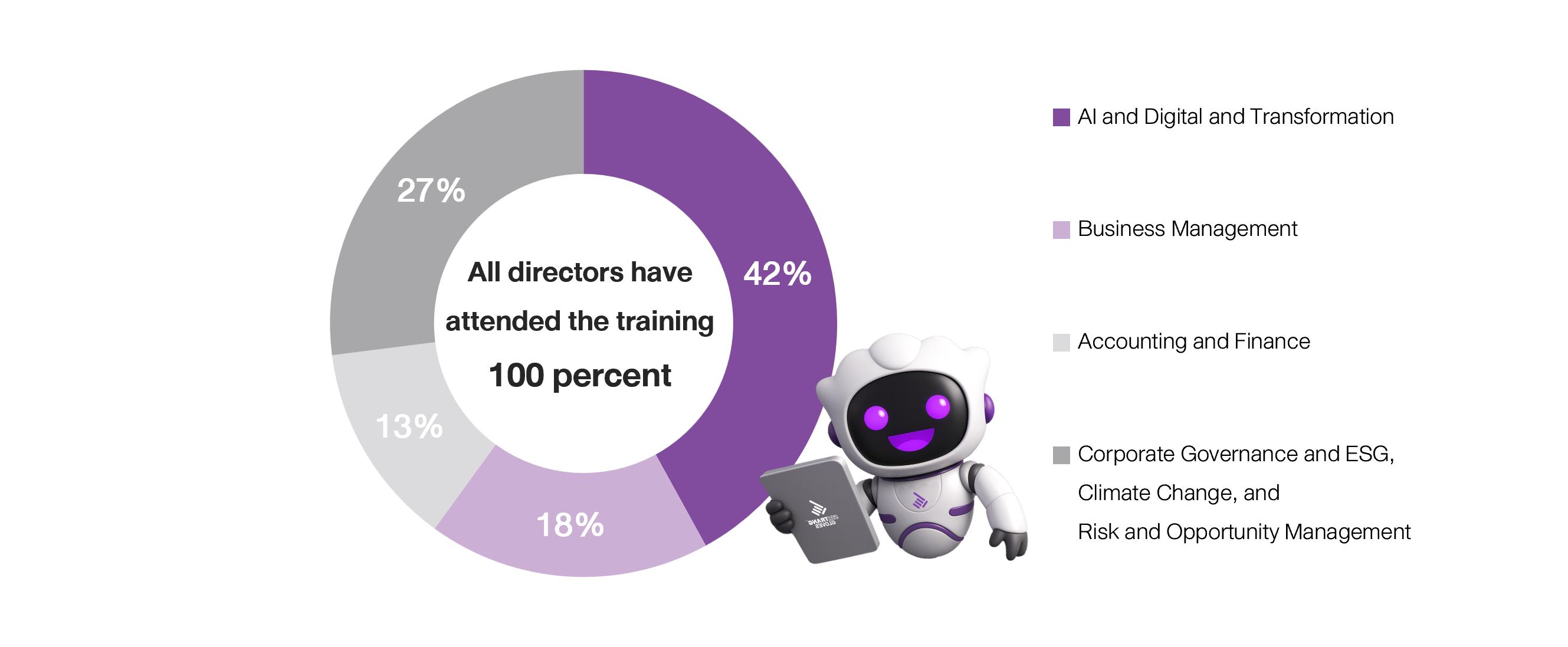
In 2025, all directors participated in various internal and external training programs relevant to their duties, with a focus on enhancing knowledge in key areas such as business management, sustainability and ESG, risk management and internal control, as well as artificial intelligence (AI) and climate change management. The proportion of training participation and examples of training courses are presented below.
Qualifications for Director Selection — Introduction
Chairman and members of the Board of Directors shall have the following qualifications and shall not possess any of the following prohibited characteristics:
(1) Having knowledge, capability and experience that contributes to the business operation of the Company, being loyal, honest and having the integrity in business operations, dedicating the knowledge and capability into the performance of duties and being capable to devoting sufficient time for the performance of duties for the Company;
(2) Having qualifications and not having prohibited characteristics under the Public Limited Company Act, B.E. 2535 (as amended), the Securities and Exchange Act, B.E. 2535 (as amended) or with the requirements of the SEC including other relevant rules and regulations, and not possessing any untrustworthy characteristics to manage business of public shareholders in accordance with the requirements of the SEC.
(3) Directors may hold an office as a director in other companies. However, such directorship shall not obstruct the performance of duties of directors for the Company and shall be in accordance with guidelines of the SEC and the SET.
(4) Directors shall not carry out business of similar nature with or in competition with that of the Company, or become partners in an ordinary partnership or partners with unlimited liabilities in a limited partnership or directors in such other private or public limited company which conducts business of similar nature with or in competition with that of the Company irrespective of whether such will be for their own personal benefits or for the benefit of others unless the general meeting of shareholders is notified thereof prior to resolving on the appointment of such directors.
(5) Independent directors shall not perform any executive functions and shall be independent from the management and shareholders who exercise their controlling power. Independent directors shall safeguard benefits of all shareholders equally to prevent conflict of interests and shall attend the Board of Directors’ meetings to express their independent opinion. They shall not have any business relationship with the Company and its subsidiaries in a manner that could restrict their independent opinions.
(6) Independent directors and the Audit Committee shall be fully qualified in accordance with the requirements under the Notification of the Capital Market Supervisory Board, and the requirements of the SEC and the SET and shall act within the scope of duties and responsibilities in accordance with the requirements of the SET.
Qualifications for Director Selection
| Qualification | Skill & Expertise |
|---|---|
| 1. Qualifications of directors to be in line with relevant laws and regulations. 2. To consider the structure of the Board of Directors, such as the number of directors that is suitable for the size and business strategy of the Company, the diversity in the structure of the Board of Directors (Board Diversity), including but not limited to, race, religion, national origin and gender. 3. The appropriateness of the qualifications and skills of the director(s) that are necessary but lacking in the Board of Directors. The Board Skill Matrix will be used to identify the required qualifications. 4. Definition and qualifications of independent directors (for individuals to be nominated as independent directors) | 117 · Description: Personal Products & Pharmaceuticals · 141 · Description: Law · 143 · Description: Accounting · 144 · Description: Finance · 3271 · Other name: such as business management, internal audit, marketing, innovation, automation technology, digitalization, and artificial intelligence (AI), as well as engineering, sustainable development, good corporate governance, risk and opportunity management, and climate change management, together with other skills and proficiencies that are consistent with the organization’s development strategies (Please see the Board Skill Matrix for more details). · Description: Others |
Evaluation of Board & Subcommittee Performance
Evaluation — Introduction
The Board of Directors conducts an assessment of its annual performance through both individual evaluation (Self-assessment) and group evaluation (As a Whole), as well as the assessment of the performance of the Sub-Committees and Chief Executive Officer via an online system. The assessment forms are based on the form of SET and designed for the Company’s business. The assessment result will be used as a framework for reviewing performance, identifying problems and obstacles, bringing suggestions to further develop and improve their performance, and supporting decisions regarding the director’s remuneration.
In 2025, the Nomination Committee reviewed the performance evaluation forms for the Board of Directors, Sub-Committees, and the Chief Executive Officer to ensure consistency with the Company’s operational approach and strategic objectives. The Committee considered that the existing evaluation forms remain appropriate and sufficiently cover all key areas relevant to the duties of each committee and the Chief Executive Officer. Therefore, no revisions were required for the year.
Criteria for Evaluating Board Performance
Method and Criteria of Assessment
Assessment Topics
Assessment of the Performance of the Board of Directors (Group Evaluation) | Assessment of the Performance of the Board of Directors (Individual Evaluation) | Assessment of the Performance of Sub-Committees |
1. Structure and Qualifications of the Board of Directors | 1. Fiduciary Duty to manage the Company’s business operations in the best interest of the shareholders | 1. Structure and Qualifications |
2. Roles, Duties and Responsibilities of the Board of Directors | 2. Structure and Qualifications of the Board of Directors | 2. Performance of Duties |
3. Board of Directors’ Meetings | 3. Board of Directors’ Meetings | 3. Meetings |
4. Performance of Directors | 4. Roles, Duties and Responsibilities of the Board of Directors | 4. Roles, Duties and Responsibilities |
5. Relationships with the Management | 5. Training / Source of Information | |
6. Personal Development of Directors and Executives |
Scoring Criteria
Score | Remark |
1 | Strongly disagree or never conducted |
2 | Disagree or seldom conducted |
3 | Agree or moderately conducted |
4 | Mostly agree or well conducted |
5 | Strongly agree or excellently conducted |
Assessment criteria
Average Score (%) | Remark |
90 - 100% | Excellent |
76 - 89% | Very Good |
66 - 75% | Good |
50 - 65% | Fair |
Less than 50% | improvement needed |
The Company Secretary will provide and collect the self-assessment forms of the Board of Directors, Sub-Committees, and Chief Executive Officer. After receiving the assessment result of each director, it will be calculated for total average score and report such result to the Board of Directors’ Meeting for acknowledgement.
Evaluation of Board Performance in the Past Year
1. Summary of the Self-Assessment Results of the Board of Directors and Sub-Committees for the year 2025 is as follows:
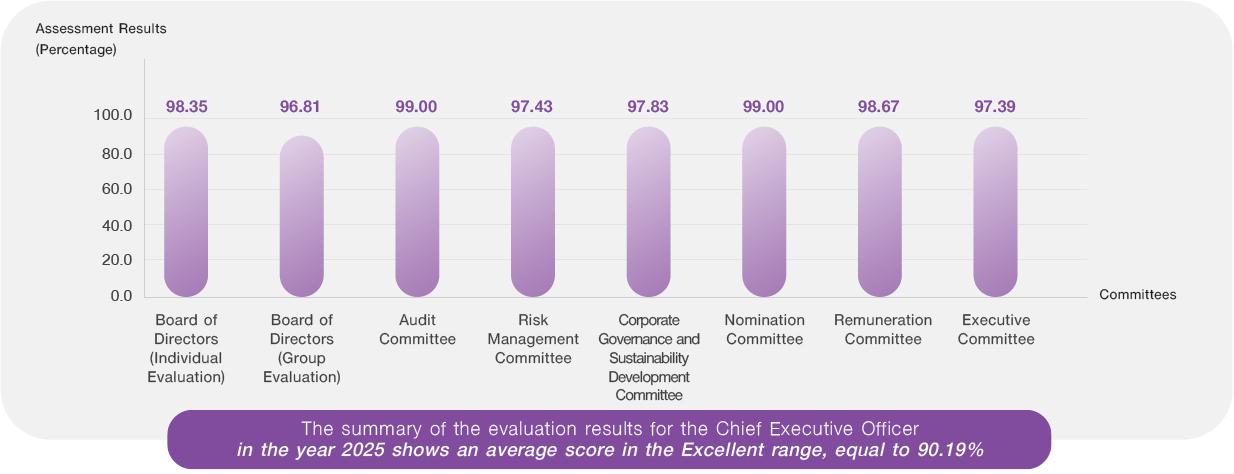
2. The summary of the performance evaluation of the Chief Executive Officer for the year 2025. The average score was in excellent level or equivalent to 90.19 percentage. The evaluation form contains 3 sections as follows:
Assessment Topics |
Section 1: Progress of Operation Plan to evaluate performance against targets and business progress |
Section 2: Performance Measures |
1. Leadership |
2. Strategy Formulation |
3. Strategy Execution |
4. Financial Planning/Performance |
5.Relationships with the Board |
6. External Relations |
7. Human Resources Management / Relations |
8. Succession |
9. Product/Service Knowledge |
10. Personal Qualities |
Section 3: Development to evaluate key strengths of the CEO and high-level executives and improvement issues for next year |
Evaluation Results
| Evaluated Body | Group — Carried Out? | Group — Grade / Average Score | Group — Grade / Full Score | Individual (Self-Assessment) — Carried Out? | Individual (Self-Assessment) — Grade / Average Score | Individual (Self-Assessment) — Grade / Full Score | Cross (Assessing Other Directors) — Carried Out? |
|---|---|---|---|---|---|---|---|
| Board Of Director | Y | 96.81 | 100 | Y | 98.35 | 100 | N |
| Audit Committee | Y | 99.00 | 100 | N | N | ||
| Other Subcommittee | Y | 97.43 | 100 | N | N | ||
| Other Subcommittee | Y | 97.83 | 100 | N | N | ||
| Other Subcommittee | Y | 99.00 | 100 | N | N | ||
| Other Subcommittee | Y | 98.67 | 100 | N | N | ||
| Executive Committee | Y | 97.39 | 100 | N | N |
Subcommittees
Subcommittees
| Results of the Subcommittee's Duty Performance | Meetings — Introduction |
|---|---|
Gen. Bundit Boonyapan Chairman of Nomination Committee | The Board of Directors has appointed the Nomination Committee to consider and determine the criteria and selection format for the nomination and selection of persons to be appointed as directors, members of sub-committees and Chief Executive Officer with transparency in accordance with good corporate governance policy to build confidence and credibility among stakeholders, promote added value and sustainable growth of the Company. The Nomination Committee consists of 3 directors, with Gen. Bundit Boonyapan, an independent director, serving as the Chairman. 66.67 percent of the members are Independent Directors, and 100 percent of the members are Non-executive Directors. In 2025, the Nomination Committee held a total of 3 meetings, with all members attending every meeting, representing an average attendance rate of 100 percent. All meetings of the Nomination Committee during the year were conducted through electronic conference. The individual attendance details and key responsibilities of the Nomination Committee are summarized as follows: |
(1) The director would receive the highest monthly remuneration from only one of the positions he/she held. (2) Meeting allowances are paid only to independent directors who serve on sub-committees, and only for actual attendance. (3) No other forms of remuneration, welfare, or additional benefits are provided to directors beyond those specified above.
Professor Dr. Weerakorn Ongsakul Chairman of Remuneration Committee | The Board of Directors has appointed the Remuneration Committee to consider the remuneration of directors, members of sub-committees and Chief Executive Officer with fairness and reasonableness in accordance with the good corporate governance policy to build confidence and credibility to the stakeholders, as well as to promote added value and sustainable growth of the Company. The Remuneration Committee consists of 3 directors, with Professor Dr. Weerakorn Ongsakul, an independent director, serving as the Chairman. 66.67 percent of the members are Independent Directors, and 100 percent of the members are Non-executive Directors. In 2025, the Remuneration Committee held a total of 2 meetings, with all members attending every meeting, representing an average attendance rate of 100 percent. All meetings of the Remuneration Committee during the year were conducted through electronic conference. The individual attendance details and key responsibilities of the Remuneration Committee are summarized as follows: |
Mr. Veerasith Sinchareonkul Chairman of the Risk Management Committee | The Board of Directors recognizes the importance of enterprise risk management and the need to have a systemic and efficient risk control regimen under the changing conditions and continuous expansion of the business to ensure that the enterprise risks are adequately continuously and appropriately managed and maintained under the acceptance level through the effective and continuous implementation of risk management and the promotion of a corporate risk management culture. To achieve the business goals and sustainable business growth including providing appropriate maximum benefits to all groups of stakeholders. Therefore, the Risk Management Committee has been appointed to establish risk management policy framework and guidelines, promotes the implementation of risk management throughout the organization, oversees the operations of enterprise risk management in accordance with the organization's strategy and goals, and monitors the overview of major risk control to be within the risk appetite. In addition, the Committee also provides comments and recommendations for the most effective risk management strategies in terms of operational, finance, legal/regulatory compliance, emerging, and ESG risks that may significantly affect business operations. In 2025, the Risk Management Committee held a total of 4 meetings, with all members attending every meeting, representing an average attendance rate of 100 percent. All meetings of the Risk Management Committee during the year were conducted through electronic conference. The individual attendance details and key responsibilities of the Risk Management Committee are summarized as follows: |
- Corporate Governance Policy - Code of Conduct - Anti-Corruption Policy and related guidelines - Whistleblowing Policy - Policy for the Prevention of Conflict of Interests - Policy for the Use of Inside Information - Corporate Social Responsibility Policy
Gen. Bundit Boonyapan Chairman of Corporate Governance and Sustainable Development Committee | The Board of Directors has appointed the Corporate Governance and Sustainable Development Committee to perform the duties of considering and determining the policies and guidelines in relation to principles of good corporate governance, code of conduct, anti-corruption, social responsibility, and sustainable development. The Committee is also responsible for overseeing climate change-related issues and reducing greenhouse gas emissions. This leads to a management governance system established with transparency and fairness in order to develop trust for stakeholders, create added value and enhance competitiveness for the sustainable growth of the Company. The Corporate Governance and Sustainable Development Committee consists of 4 directors, with Gen. Bundit Boonyapan, an Independent Director, serving as the Chairman. Independent directors account for 25 percent of the Committee, while Non-Executive Directors represent 50 percent. In 2025, the Committee held a total of 6 meetings, with all members attending, with an average attendance rate of 91.67 percent. All meetings of the Corporate Governance and Sustainable Development Committee during the year were conducted through electronic conference. The individual attendance details and key responsibilities of the Corporate Governance and Sustainable Development Committee are summarized as follows: |
Meeting Attendance & Remuneration
Meeting Attendance — Sub-section Introduction
Meetings of the Board of Directors and Sub-Committees
The Board of Directors schedules annual meetings in advance whereby a meeting calendar is prepared for the Board of Directors and sub-committees, specifying the key agenda items for each meeting, whereby directors and executives are notified within December of every year before the following year's meetings so that directors and executives can plan to allocate time to attend such meetings.
For Board of Directors meetings, to comply with the principles of good corporate governance, in 2025, the Company scheduled at least 1 meeting per quarter, with a minimum of 6 meetings per year. The meetings are set to take place during the first and/or second week of February, May, August, and November. The Company promotes and encourages each director to attend the Board of Directors’ meeting at least 75 percent of the total number of meetings in each fiscal year and supports providing the meeting materials to the directors in advance at least 7 days prior to the meeting except in case of necessity. In addition, the non-executive directors will hold a meeting at least once a year in order to allow a discussion on any issues of concern without the attendance from the management as well as holding an extra meeting to consider, review, and follow up the performance in accordance with vision, mission, core value, and strategy of the Company, and to determine the mission of the Company for next year.
In addition, the Board of Directors has established a policy regarding the minimum number of quorums in the meeting of the Board of Directors while voting at the meeting requires no less than two-thirds of the total number of directors.
For Sub-Committee meetings, the Audit Committee will hold a meeting on a quarterly basis and may call additional meetings as necessary and appropriate, including an extraordinary meeting with the auditor of the Company without the executives in attendance at least once a year. Additionally, a joint meeting with the Risk Management Committee should be held at least once a year to exchange views and foster a mutual understanding of enterprise risks and appropriate internal audits. The Nomination Committee, the Remuneration Committee, the Corporate Governance and Sustainable Development Committee, and the Risk Management Committee will hold at least two meetings in each fiscal year and may call additional meetings as necessary and appropriate. The Executive Committee will hold its meetings at least four times a year, in accordance with its charter, with additional meetings held as necessary.
In 2025, Board of Directors Meetings No. 1 - 7/2025 were conducted through electronic conference, while Meeting No. 8/2025 was held physically at the designated meeting venue. The 2025 Annual General Meeting of Shareholders, as well as all Sub-Committee meetings during the year, were conducted through electronic conference. The details of meeting attendance are as follows:
Justification for Directors' Non-Attendance
Mr. Chia Chee Ping did not attend the Board of Directors Meeting No. 1/2025 on 3 February 2025 due to overseas marketing duties.
Meeting Attendance — Remark
Types of Remuneration of the Board of Directors
Policy and Criteria of Remuneration and Structure of Remuneration for Directors and Executives
The Board of Directors at recommendation of the Remuneration Committee is to consider the structure and rate of remuneration for both executive and non-executive directors, as well as executives to be commensurable with their responsibilities and to motivate and lead the organization to achieve both short-term and long-term goals. The criteria for determining and providing remuneration for Executive and Non-Executive Directors are as follows:
(1) The remuneration must be in line with the Company's long-term strategy and goals.
(2) Their experience, duties, scope of roles, accountability, and responsibility, including the benefits expected to
be received from each director.
(3) Comparable to the level practiced in the industry.
The shareholders will approve the structure and rate of remuneration of directors, both in monetary and non-monetary terms. The Board of Directors, as advised by the Remuneration Committee, will consider the appropriate type of compensation in connection with the value that the Company created for shareholders but not at a level that is too high to focus on short-term earnings. The Remuneration Committee will establish remuneration criteria that reflect the duties and responsibilities of each director. The Remuneration Committee may recruit an advisor or a person with an independent opinion to provide opinions or advice on methods for determining the remuneration of directors and executives as necessary and appropriate.
Remuneration of the Board — Introduction
Monetary Remuneration
The Remuneration Committee has considered and established criteria, structure, and policy for determining the directors’ remuneration to be in accordance with the Company’s performance result, meeting attendance, and performance, and concluded that it is in line with the same industry standards as well as sufficient to motivate and retain quality directors to work with the Company, and further purpose to the Annual General Meeting of Shareholders for consideration and approval in an annual basis. In this regard, the Annual General Meeting of Shareholders, which held on 9 April 2025, passed the resolution to determine the directors’ remuneration for the year 2025, including an increase in both monthly remuneration and meeting allowance for for the Board of Directors and Sub-committees, to reflect the increased responsibilities and performance of each director, in accordance with the aforementioned criteria. The details are as follows:
Types of Directors (For Executive and Non-Executive Directors) | *Monthly Remuneration (per month / person) |
Chairman | 120,000 |
Director / Independent Director | 89,000 |
Chairman of Audit Committee | 120,000 |
Member of Audit Committee | 99,000 |
Chairman of Executive Committee | 120,000 |
Member of Executive Committee | 99,000 |
Types of Directors (For Independent Directors Only) | **Meeting Allowance (per attendance / person) |
Board of Directors | None |
Audit Committee | None |
Executive Committee | None |
Nomination Committee | 4,000 |
Remuneration Committee | 4,000 |
Risk Management Committee | 4,000 |
Corporate Governance and Sustainable Development Committee | 4,000 |
Remuneration or Benefits Payable to the Board
| Metric | Amount (Baht) |
|---|---|
| Remunerations or benefits pending payment to the board of directors over the past year (baht) | 0 |
Supervision of Subsidiaries & Associated Companies
Supervision of Subsidiaries — Introduction
The Company establishes a corporate governance policy for the supervision and management of subsidiary and associate companies. The objective is to define direct and indirect measures and mechanisms for the Company to be able to supervise and manage the affairs of its subsidiaries and associate companies, including monitoring and supervising their compliance with said measures and mechanisms as if they are the Company's own units, and in accordance with the Company's policy Including public company laws, the Civil and Commercial Code, Securities Law and other related laws and notices, relate rules and regulations of the Capital Market Supervisory Board, the SEC Office and the SET in order to protect the interests of the Company's investments in such subsidiaries and associate companies, details of which are as follows:
Does the Company Have Subsidiaries or Associated Companies?
Yes
Is There a Mechanism for Overseeing Subsidiaries and Associated Companies?
Yes
Mechanism for Overseeing Management of Subsidiaries
1. The Company will assign someone to represent the Company as a director in each subsidiary and/or associate company according to the percentage of shareholding in each company to supervise said subsidiaries and/or associate companies to act in accordance with the relevant laws, good corporate governance policy, as well as other policies of the Company. Such assignment in each subsidiary and/or associate company must be considered and approved by the Board of Directors' meeting, taking into account the suitability of each company.
2. If entering into the transaction or any operation of a subsidiary falls into or is deemed an acquisition or disposition of assets under the Notification on Acquisition or Disposition of Assets or a connected transaction according to the relevant connected transaction announcements, the Company has the duty to seek approval from the Board of Directors’ meeting and/or seek approval from the shareholders' meeting of the Company, or seek approval from the relevant authorities according to the law before entering into the transaction. Therefore, subsidiaries may enter into the transaction or proceed with said operation only upon the completion of the approval process of the Board of Directors' meeting and/or the shareholders' meeting of the Company and/or related agencies (as the case may be.
In addition, if in entering into the transaction or there is any event of the subsidiary resulting in the Company having to disclose information to the Stock Exchange of Thailand in accordance with the rules prescribed in the relevant notifications thereof, directors representing the Company on the board of directors of the said subsidiary have a duty to notify the Company's management immediately upon becoming aware that the subsidiary plans to enter into the transaction or if such an event occurs.
3. The Board of Directors and Management of each subsidiary and/or associate company will have the scope of important authority and responsibility under the relevant laws that require such acts as disclosing information on financial status and operating results to the Company. In this regard, the relevant announcements of the Capital Market Supervisory Board and the notifications of the Stock Exchange of Thailand shall apply mutatis mutandis. Also required is disclosure and submission of information on personal interests and interests of related persons to the Board of Directors so that it is aware of the relationship and transactions with the Company, subsidiaries and/or associate companies that may create a conflict of interest and avoid such transactions that may lead to conflicts of interest.
4. The Company will set up a plan and take necessary actions to ensure that the subsidiaries and/or affiliates disclose information on operating results and financial status to the Company and the Company will take necessary actions and monitor the subsidiary and/or associate companies to have an information disclosure and internal control systems that are adequate and appropriate in their business operations.
In addition, the Company will closely monitor the operating results and operations of the said subsidiary and/or associate company and present the results of analysis as well as express opinions or recommendations to the board of directors of the Company and the board of directors of the subsidiaries or associate companies for use in considering policy formulation or enhancement to promote the business of subsidiaries and/or associate companies for continuous development and growth.
Furthermore, the Company has designated the Internal Audit Department, which reports directly to the Audit Committee, to regularly audit and assess the internal controls of the subsidiaries in accordance with the internal audit plan. The annual audit plan is consistent with the Company’s strategic direction and its digital and innovation development roadmap to enhance organizational capability. The plan is developed based on key risks affecting operations, processes, systems, internal control, governance, performance monitoring, and requests from management and/or the Audit Committee, where applicable, to ensure the adequacy and appropriateness of preventive internal controls for each activity. During the year, the internal audit plan was reviewed to remain consistent with the business plan and major business risks. In cases where issues or obstacles prevented the implementation of recommendations from the Internal Audit Department or the Audit Committee, the Internal Audit Department consulted with management to identify alternative solutions or establish compensating internal controls to address such issues.
In addition, the Company arranged a visit for the Audit Committee, Independent Directors, and the management team to the subsidiary in Vietnam during 28-30 October 2025 as part of the annual audit plan. The visit included a tour of the warehouse and office facilities of Sri Trang Gloves Vietnam Co., Ltd. (STGV) and a briefing on operational performance by the local management team, along with strategic discussions to support business development. This visit underscores the Group Company’s commitment to good corporate governance, transparency, stakeholder confidence, and sustainable cross-border collaboration.
To ensure that shareholders are confident that the Company has a transparent and auditable operating structure, the Company has clearly disclosed the shareholding structure in its subsidiaries in this report and on the Company's website https://www.sritranggloves.com/en/corporate-info/management-structure/shareholding-structure-of-the-group
Oversight Mechanisms
| Mechanism |
|---|
| Sending representatives to act as directors, executives or controlling persons in proportion to shareholdings |
| Defining the scope of powers, duties and responsibilities of directors and executives who represent the company in setting important policies |
| Disclosure of financial information and operating results |
| Transactions between the Company and related persons |
| Other important transactions |
| Acquisition or disposal of assets |
| Internal control system of the subsidiary operating the core business is appropriate and sufficient in the subsidiary operating the core business |
Audit Committee Duty Performance
Results of the Audit Committee's Duty Performance in the Past Year
Reviewed quarterly financial reports and financial statements for the year 2025 in accordance with generally accepted accounting standards whereby the Committee attended meetings with external auditors, the Chief Financial Officer (CFO) and the Management to review the information, the accuracy of the financial statements of the Company and its subsidiaries with a focus on the main issues, listening to clarifications and asking questions and exchanging opinions on various matters before giving its approval to propose said financial statements to the Board of Directors for approval. In addition, the Audit Committee held a meeting with the auditor without attendance of the Management, namely the Audit Committee Meeting No. 1/2026 on Thursday 19 February 2026. The auditor did not have any material remarks.
Reviewed the connected transactions of the Company and disclosure of information regarding the connected transactions of the Company with related companies to ensure that the Company has operated in accordance with the business conditions and the prescribed rules of the SET and the SEC. The Audit Committee has assigned the Internal Audit Department to review the connected transactions of the Company and report to the Audit Committee. The review of connected transactions was found to be the normal conduct of business of the Company, entering into a commercial agreement in the same way that a reasonable person would do with a general contracting party in similar circumstances. The size and type of connected transactions required to be disclosed in accordance with the specified regulations have been disclosed completely, correctly, and sufficiently in compliance with the rules and announcements by the SEC and the SET.
Considered and selected the appointment of auditors and proposed audit fees for the year 2025 to be presented to the Board of Directors for submission to and approval from the 2025 Annual General Meeting of Shareholders, whereby the Audit Committee based its consideration on their performance and independence as well as the appropriateness of the remuneration.
Reviewed non-audit services to ensure compliance with the principles of good corporate governance regarding the appropriateness and independence of the auditor.
Reviewed, and approved the internal audit plan prepared by the Internal Audit Department on the basis of risk assessment and reviewed the internal audit report every quarter, including giving suggestions on how to improve the internal audit process to increase efficiency and effectiveness as well as continually monitoring the progress of the management's improvement plans.
Reviewed the internal control system to assess its sufficiency and effectiveness and, when considering the internal audit report for the year 2025, which covers the important work systems of the Company, the Audit Committee is of the opinion that the Company's internal control system is sufficient and appropriate.
Considered the Enterprise Risk Management Assessment, along with risk management guidelines to ensure that risk management is consistent and effective. In 2025, the Audit Committee held a meeting with the Risk Management Committee to discuss key enterprise risks for the year 2026 and assigned the Internal Audit department to plan the internal auditor's activities to be in accordance with the assessment results.
Reviewed the Company’s compliance with relevant legal and regulatory requirements and good corporate governance principles, whereby it has provided oversight and supervision with regard to compliance with the Company's regulations, requirements of the SEC and SET, including relevant laws and good corporate governance principles as well as ensuring sufficient and transparent disclosure of information.
Reviewed the Audit Committee Charter, with the Audit Committee regularly reviewing and revising the appropriateness of the Charter on an annual basis, with consideration on its alignment with best practices and the regulations of the SEC, the SET, and the Capital Market Supervisory Board.
The Audit Committee reviewed the Company’s Anti-Corruption Policy and guidelines and considered that the policy is comprehensive and appropriate, with no revisions required. The Committee further recommended that the Whistleblowing Policy be enhanced to be in line with international sustainability assessment standards, thereby strengthening the Company’s overall corporate governance framework. In addition, the Audit Committee acknowledged the internal investigation reports related to fraud cases, provided recommendations, and prescribed preventive measures to avoid recurrence, thereby reinforcing the effectiveness of the Company’s internal control and risk management systems.
Considered and Approved the Company’s participation in the CAC Change Agent Program, a special project by the Thai Private Sector Collective Action Against Corruption (CAC), which invites CAC-certified companies that prioritize expanding transparent business networks to encourage their business partners to join the CAC SME Certification Program. Through the Company’s efforts in promoting more than 10 business partners to declare their intention to prevent corruption within one year, the Company was awarded the highest level 3-Star CAC Change Agent status in May 2025 and received the CAC Change Agent Award 2025 on 24 November 2025. Professor Dr. Weerakorn Ongsakul, Chairman of the Audit Committee, represented the Company in receiving the award at the CAC Certification Ceremony No. 2/2025, organized by the IOD and the CAC.
Reviewed the results of the 2025 Quality Assurance and Improvement Program (QAIP) assessment of the Internal Audit Department. The Committee evaluated the assessment scope, methodology, results, and recommendations in accordance with the International Standards for the Professional Practice of Internal Auditing issued by the Institute of Internal Auditors (IIA). The Committee concluded that the Internal Audit Department operated in full compliance with professional standards, maintained independence and objectivity, and effectively supported the Company’s governance, risk management, and internal control frameworks. The Committee provided developmental recommendations and monitored the Internal Audit Department’s implementation of improvement plans to continuously enhance audit quality and effectiveness in line with best practices and the Company's evolving environment.
Conducted the annual performance evaluation of the Audit Committee for the year 2025 and achieved a score of 99.00 percent, rated as "Excellent". This evaluation result reflects that the Committee has effectively and comprehensively performed its duties and responsibilities in accordance with its charter and the assignments from the Board of Directors, while also adhering to good corporate governance principles.
In October 2025, the Audit Committee conducted a site visit to STGV together with senior executives as part of the annual audit plan. The visit aimed to ensure that operations are aligned with good corporate governance principles and to enable the Company to consider and apply the Committee’s recommendations for the benefit of the organization.
In summary, the Audit Committee is of the opinion that the Company’s internal control system and risk management practices during the past year were adequate and appropriate. Financial information reports have been prepared in accordance with generally accepted accounting principles. The Company follows the law on securities and exchange, regulations of the SET, as well as laws related to the Company's business. The Audit Committee performed its duties independently, exercised its authority and judgment freely, and no restrictions were placed in accessing all the relevant information.
Professor Dr. Weerakorn Ongsakul
Chairman of Audit Committee
Executive Committee Duty Performance
Results of the Executive Committee's Duty Performance in the Past Year
Considered, established, and reviewed the Company’s and its subsidiaries’ policies, direction, vision, business strategies, operational plans, financial goals, annual budgets, and the delegation of management authority, in collaboration with the management team, for submission to the Board of Directors for approval.
In 2025, the Company revised its mission to “Empowering AI” as the guiding direction for operations in 2026. This mission aims to drive the transformation of artificial intelligence (“AI”) from concept to practical implementation with tangible outcomes. The Company is committed to integrating AI across all areas of the organization and continues to advance its Manufacturing AI technology (Sri Trang AI Machine or “SAM”) to improve efficiency, accuracy, and innovation in the production process. The Company also plans to expand AI integration across all aspects of its operations in the future, ranging from basic AI applications to advanced intelligent systems and aims to empower the organization and its people with practical, impactful AI that supports meaningful transformation toward a smarter and more sustainable future for all.
To consider and approve ordinary transactions of the Company in accordance with the investment plans or budgets under the authority delegated by the Board of Directors, including entering into related agreements such as land acquisitions, the share repurchase program for financial management purposes, and the Entire Business Transfer (EBT) from Sadao P.S. Rubber Co., Ltd. (“PS”), a subsidiary, to streamline the Group Company’s structure, enhance management flexibility, and reduce operating costs. The Committee also monitored the progress of key projects and reviewed investment plan adjustments to ensure consistency with the Company’s business situation and industry.
Reviewed the Executive Committee Charter and considered that it remains appropriate and consistent with best practices, as well as with the regulations of the SEC, the SET, and good corporate governance principles. The Charter continues to support efficient operations. Therefore, no amendments were made.
Conducted the annual performance evaluation of the Executive Committee for the year 2025 and achieved a score of 97.39 percent, rated as "Excellent". This evaluation result reflects that the Committee has effectively and comprehensively performed its duties and responsibilities in accordance with its Charter and the assignments from the Board of Directors, while also adhering to good corporate governance principles.
Mr. Vitanath Sincharoenkul
Chairman of Executive Committee
Remark
Mr. Vitanath Sincharoenkul was appointed as Chairman of the Executive Committee, replacing Dr. Viyavood Sincharoenkul, and Dr. Viyavood Sincharoenkul was appointed as Honorary Chairman of Executive Committee on 20 December 2025.