

Sustainability · 2025
In this section55 topics
- Sustainability Policy2 items
- Sustainability Goals & UN SDGs3 items
- Policy Review3 items
- Business Value Chain1 item
- Stakeholder Analysis2 items
- Environmental Sustainability — Overview1 item
- Environmental Policy & Guidelines3 items
- Environmental Policy Review3 items
- Energy — Plan & Guidelines2 items
- Energy — Electricity Consumption1 item
- Energy — Fuel Consumption1 item
- Energy — Targets2 items
- Energy — Performance & Outcomes2 items
- Water Management — Overview1 item
- Water — Plan & Guidelines2 items
- Water — Withdrawal, Discharge & Consumption1 item
- Water — Targets2 items
- Water — Performance & Outcomes2 items
- Waste Management — Overview1 item
- Waste — Plan & Guidelines2 items
- Waste — Generation, Disposal & Recycling3 items
- Waste — Targets2 items
- Waste — Performance & Outcomes2 items
- GHG — Plan & Guidelines2 items
- GHG — Emissions2 items
- GHG — Emissions Verification3 items
- GHG — Principles & Standards1 item
- GHG — Targets1 item
- GHG Targets — Net Zero1 item
- GHG Targets — Other Targets1 item
- GHG — Performance & Outcomes2 items
- Environmental Legal Incidents1 item
- Environmental Incidents — Case Detail1 item
- Other Environmental Management1 item
- Social Policy & Guidelines3 items
- Social Policy Review2 items
- Social — Principles & Standards Practised1 item
- Human Rights Due Diligence2 items
- Employees — Plan & Guidelines3 items
- Employees — Workforce2 items
- Employees — Remuneration & Provident Fund1 item
- Employees — Training & Development1 item
- Employees — Occupational Health & Safety1 item
- Employees — Labour Relations1 item
- Employees — Employee Representation2 items
- Employees — Targets2 items
- Employees — Performance & Outcomes2 items
- Customers — Plan & Guidelines3 items
- Customers — Satisfaction Results1 item
- Customers — Targets2 items
- Customers — Performance & Outcomes2 items
- Community & Social — Plan & Guidelines3 items
- Community & Social — Targets2 items
- Community & Social — Performance & Outcomes2 items
- Law Violation Incidents1 item
Sustainability Policy
Has a Sustainability Policy
Yes
Policy Description
The Company is committed to becoming a world leader in the rubber glove industry, operating with responsibility toward the environment and society throughout the value chain. This commitment is achieved through operational excellence, transparency, active participation, and continuous business development to deliver "Touch Of Life On a Global Scale" with the products and services with the highest standard of the Company as well as creating a balance between the business value and shared value for all stakeholders in supply chain, as well as contributing to the achievement of the Sustainable Development Goals (SDGs).
The Company has established the “Corporate Sustainability Policy” to promote good practices and build confidence in responsible and participatory business operations. The policy covers all 3 dimensions of sustainability, which include the following key practices:
Governance Dimension, the Company focuses on conducting business in accordance with the principles of good corporate governance and in line with Code of Conduct. The Company attaches great importance to responsibility toward all stakeholder groups, preventing all forms of fraud and corruption, emphasizing the development of innovations, products and services to meet the needs and expectations of customers by ultimately using the least amount of resources and at the lowest cost, enhancing the efficiency of asset utilization and maximizing investment value, covering risk management in the supply chain, as well as business adaptation that increasingly incorporates various technologies.
Environmental Dimension, the Company places importance on sustainable management of resources and the environment through the implementation of an environmental management standard system, covering air pollution management, water and wastewater management, and waste management and utilization of unused materials according to Circular Economy principles to reduce waste generation. The Company focuses on improving energy efficiency and promoting the use of renewable energy. Furthermore, the Company does not support deforestation and assesses biodiversity and ecosystem risks to reduce the impact of climate change and support the achievement of Net Zero Emissions targets. The Company also instills environmental and natural resource conservation awareness among employees at all levels.
Social Dimension, the Company places importance on occupational health and safety in the workplace for both employees and individuals working within the organization, employee care and development, respects and adherence to international human rights principles towards stakeholders by publishing the Policy on Human Rights and Non-Discrimination and the Social and Labor Policy. These policies also cover fair treatment of business partners and customers and participation in social responsibility and development to help solve societal problems and improve the quality of life of communities, which is regarded as one of the Company’s key social practices.
The full version of Corporate Sustainability Policy are available on the Company's website at
https://www.sritranggloves.com/en/sustainability/corporate-sustainability-policy
In 2025, The Company has established the "Clean World Clean Gloves" strategy, and continues to adhere to “SHARE” as a framework for operations to respond to corporate sustainability targets and the needs and expectations of stakeholders as follows:
1. Sustainability for Supply Chain and Fair Trade
The Company operates with the highest standards to ensure that our business partners comply with our own principles on sustainable business operations, human rights, environment awareness and business integrity. As part of our Touch Of Life, our business starts from a sustainable and fair trade of raw material through delivery of highest products quality to customers.
2. Human Rights
The Company values our employees as part of STGT family. We are committed to no child labor and no forced labor policy. Not only being against all kinds of abusive workplace, but we also commit to our human rights protection. It is our pride to earn top grade of workplace standards by the Business Social Compliance Initiative or amfori BSCI.
3. Animal Welfare
The Company is dedicated to the development of animal welfare. We deliver our giving and sharing of loves under our Touch Of LifeTM to stray animals and other wild lives in Thailand by ways of charities and varieties of CSR activities.
4. Responsibility & Sharing
The Company is committed to fostering and supporting a culture of sharing to help create a better and more sustainable society and world. This commitment is reflected through various activities, such as developing the skills of people with disabilities under the Upcycling wood pallets project, enhancing the vocational skill of prisoners through the delivery of unused materials, such as scrap metal and obsolete employee forms for use in producing various products.
5. Environmentally Friendly Technologies
The Company involves using 100 percent of biomass fuel to generate heat energy in boilers, improving energy efficiency, promoting the use of low-carbon technology and renewable energy, along with effective management of resource utilization to prevent environmental impacts, including air pollution. Additionally, the Company manages used water and wastewater, handles and utilizes waste and unused materials according to Circular Economy principles. The Company is committed to no deforestation and the conservation of biodiversity and ecosystems to mitigate the risk of environmental deterioration and moving towards green factories which is friendly to environment as well as communities around us.
Sustainability Goals & UN SDGs
Has Sustainability Goals
Yes
Goals Description
Material Topics | Targets | Performance for the year and/or cumulative performance up to 2025 |
Governance | ||
Good Corporate Governance and |
|
|
|
| |
|
| |
Cybersecurity and Data Privacy |
|
|
|
| |
Risk Management and |
|
|
|
| |
|
| |
Sustainable Supply Chain Management |
|
|
|
| |
|
| |
|
| |
Research Development and Innovation |
|
|
Social | ||
Human Rights and Non-Discrimination |
|
|
|
| |
|
| |
Workforce Management |
|
|
Human Capital Development |
|
|
Occupational Health and Safety |
|
|
|
| |
Customers Relationship and Product Quality and Safety |
|
|
Support and Participation with the Community |
|
|
|
| |
| ||
Environment | ||
Environmental Management Systems |
|
|
Climate Strategy |
|
|
|
| |
| ||
Energy Management |
|
|
Air Quality Management |
|
|
Water and Effluent Management |
|
|
Waste Management |
|
|
|
| |
Consideration of Ecosystems and Biodiversity |
|
|
Remarks:
- (1) and (3) In 2025, the Company experienced incidents of non-compliance with legal requirements pertaining to air-related environmental regulations. Nevertheless, the Company has since completed all necessary corrective actions, provided remediation to affected parties in accordance with agreed terms, and continues to monitor performance on an ongoing basis to ensure the effectiveness of such measures and the satisfaction of those affected. Details are as follows:
- Air Quality Incident: An air quality incident occurred at the Anvar Branch factory in February 2025, whereby carbon monoxide (CO) emissions from boiler stacks exceeded the prescribed regulatory standards. The factory subsequently undertook corrective measures and conducted repeat emissions measurements, the results of which confirmed compliance with applicable standards. All corrective actions were completed by May 2025.
- (2) Survey results fell below the targeted level, as scores in certain dimensions declined compared to the previous year. However, the Company has analyzed employee feedback and formulated appropriate action plans to address employee expectations and promote positive impacts on the quality of life and overall well-being of its workforce.
- (3) In 2025, the Company was unable to achieve its established water management targets. Nevertheless, the Company remains firmly committed to the efficient management of water resources and has intensified its measures and approaches to water resource management accordingly.
UN Sustainable Development Goals
| SDG Goal |
|---|
| Goal 1 No Poverty |
| Goal 2 Zero Hunger |
| Goal 3 Good Health and Well-being |
| Goal 4 Quality Education |
| Goal 5 Gender Equality |
| Goal 6 Clean Water and Sanitation |
| Goal 7 Affordable and Clean Energy |
| Goal 8 Decent Work and Economic Growth |
| Goal 9 Industry, Innovation and Infrastructure |
| Goal 10 Reduce Inequalities |
| Goal 11 Sustainable Cities and Communities |
| Goal 12 Responsible Consumption and Production |
| Goal 13 Climate Action |
| Goal 14 Life below Water |
| Goal 15 Life on Land |
| Goal 16 Peace, Justice and Strong Institutions |
| Goal 17 Partnerships for the Goals |
Policy Review
Policy Reviewed This Year
Yes
Policy Changed This Year
Yes
Review Details
In 2025, the Company reviewed, improved, and updated Sustainability Material Topics and Targets. New material topics were added, namely Cybersecurity and Data Privacy, and Artificial Intelligence. Additionally, the material topic on Greenhouse Gas Emissions Reduction was revised to Climate Change Strategy. These updates were considered, reviewed, and approved by the Corporate Governance and Sustainable Development Committee, and were subsequently approved by the Board of Directors.
More details are available in the sections "Assessment of Sustainability Material Topics" and "Progress Toward Sustainability Targets" of the 2025 Sustainability Report.
Business Value Chain
Value Chain Description
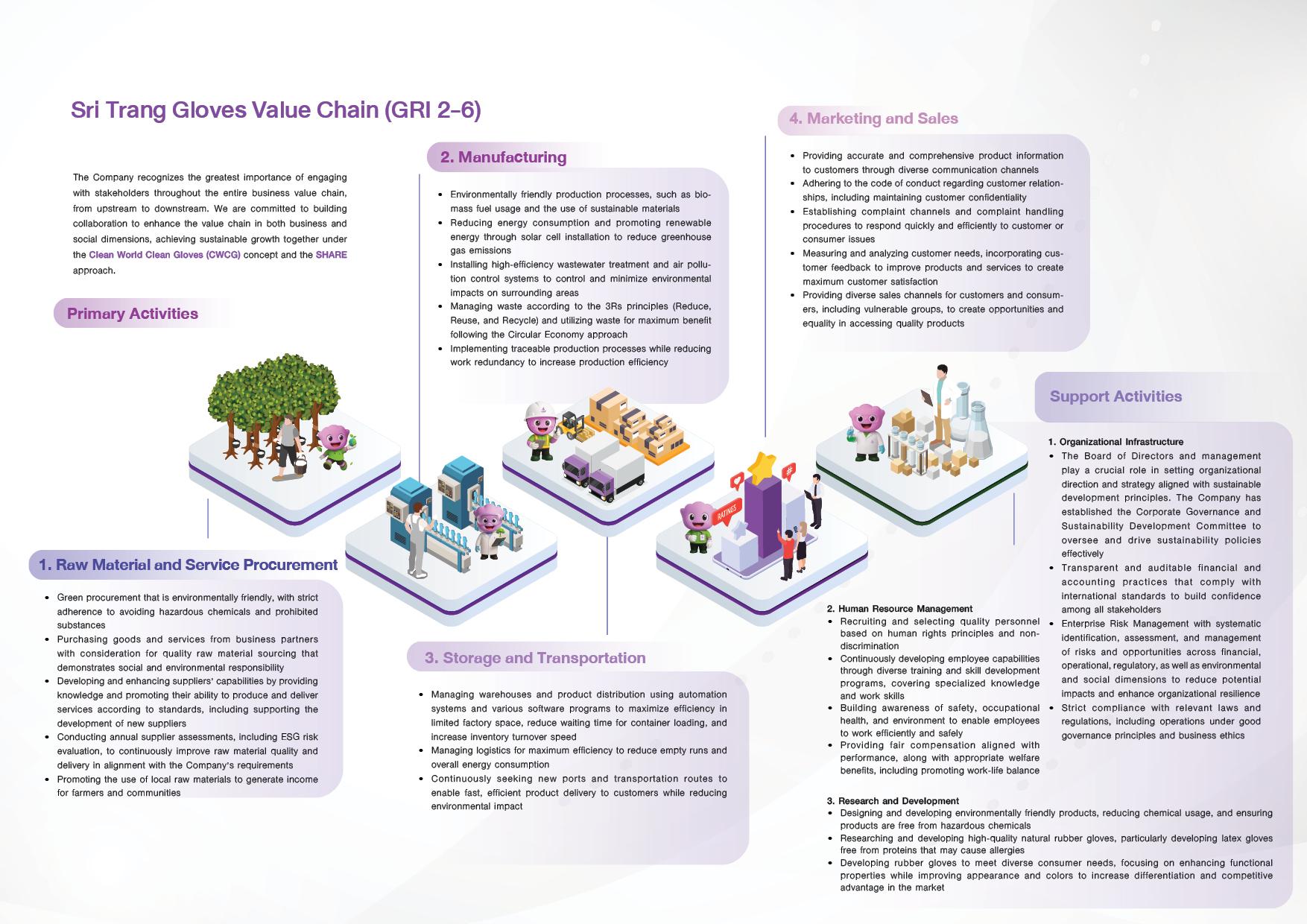
The Company recognizes the greatest importance of engaging with stakeholders throughout the entire business value chain, from upstream to downstream. The Company is committed to building collaboration to enhance the value chain in both business and social dimensions, achieving sustainable growth together.
Primary Activities
1. Raw Material and Service Procurement
Green procurement that is environmentally friendly, with strict adherence to avoiding hazardous chemicals and prohibited substances.
Purchasing goods and services from business partners with consideration for quality raw material sourcing that demonstrates social and environmental responsibility.
Developing and enhancing suppliers' capabilities by providing knowledge and promoting their ability to produce and deliver services according to standards, including supporting the development of
new suppliers.Conducting annual supplier assessments, including ESG risk evaluation, to continuously improve
raw material quality and delivery in alignment with the Company's requirements.Promoting the use of local raw materials to generate income for farmers and communities.
The Supplier Code of Conduct and Guidelines can be found on the Company's website at https://www.sritranggloves.com/en/documents/corporate-policy
2. Manufacturing
Environmentally friendly production processes, such as biomass fuel usage and the use of sustainable materials.
Reducing energy consumption and promoting renewable energy through solar cell installation to reduce greenhouse gas emissions.
Installing high-efficiency wastewater treatment and air pollution control systems to control and minimize environmental impacts on surrounding areas.
Managing waste according to the 3Rs principles (Reduce, Reuse, and Recycle) and utilizing waste for maximum benefit following the Circular Economy approach.
Implementing traceable production processes while reducing work redundancy to increase production efficiency.
3. Storage and Transportation
Managing warehouses and product distribution using automation systems and various software programs to maximize efficiency in limited factory space, reduce waiting time for container loading, and increase inventory turnover speed.
Managing logistics for maximum efficiency to reduce empty runs, minimizing transportation distances through the optimal allocation of export ports relative to the geographical location of each factory, thereby reducing overall costs and energy consumption.
Continuously seeking new ports and transportation routes to enable fast, efficient product delivery to customers while reducing environmental impact.
4. Marketing and Sales
Providing accurate and comprehensive product information to customers through diverse communication channels.
Adhering to the code of conduct regarding customer relationships, including maintaining customer confidentiality.
Establishing complaint channels and complaint handling procedures to respond quickly and efficiently to customer or consumer issues.
Measuring and analyzing customer needs, incorporating customer feedback to improve products and services to create maximum customer satisfaction.
Providing diverse sales channels for customers and consumers across all regions and industries, creating equal and accessible opportunities to obtain quality products.
Support Activities
1. Organizational Infrastructure
The Board of Directors and management play a crucial role in setting organizational direction and strategy aligned with sustainable development principles. The Company has established the Corporate Governance and Sustainability Development Committee to oversee and drive sustainability policies effectively.
Transparent and auditable financial and accounting practices that comply with international standards to build confidence among all stakeholders.
Enterprise Risk Management with systematic identification, assessment, and management of risks and opportunities across financial, operational, regulatory, as well as environmental and social dimensions to reduce potential impacts and enhance organizational resilience.
Strict compliance with relevant laws and regulations, including operations under good governance principles and business ethics.
2. Human Resource Management
Recruiting and selecting quality personnel based on human rights principles and non-discrimination.
Continuously developing employee capabilities through diverse training and skill development programs, covering specialized knowledge and work skills.
Building awareness of safety, occupational health, and environment to enable employees to work efficiently and safely.
Providing fair compensation aligned with performance, along with appropriate welfare benefits, including promoting work-life balance.
3. Research and Development
Designing and developing environmentally friendly products, reducing chemical usage, and ensuring products are free from hazardous chemicals.
Researching and developing high-quality natural rubber gloves, particularly developing latex gloves free from proteins that may cause allergies.
Developing rubber gloves to meet diverse consumer needs, focusing on enhancing functional properties while simultaneously pursuing production cost reduction to minimize resource consumption, without compromising product quality or service standards.
Stakeholder Analysis
Introduction
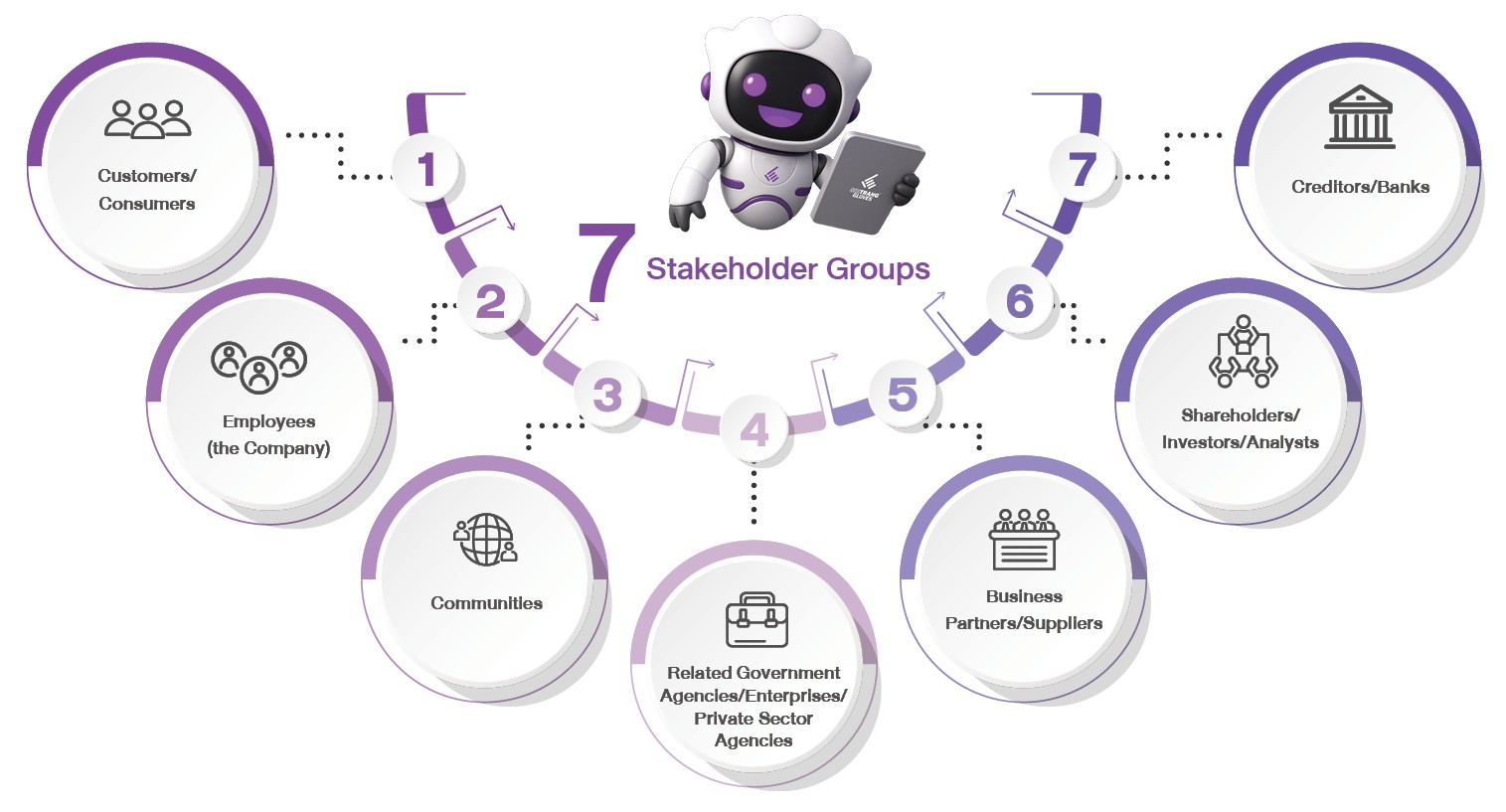
The Company has conducted a survey, analysis, and prioritization of stakeholders by considering criteria based on the level of impact from the Company's operations on stakeholder groups and the level of influence of stakeholder groups on business operations. This ensures appropriate responses to stakeholder expectations regarding the Company's business operations. The Company has designated responsible units, duties, and operations in accordance with established guidelines. Stakeholder needs and expectations are reviewed once annually, and response methods are improved as appropriate.
In 2025, the Company classified stakeholders into seven groups, prioritized as follows: Customers/Consumers, Employees (Company), Communities, Government Agencies/Enterprises/Related Private Sector Agencies, Shareholders/Investors/Analysts, Business Partners/Suppliers and Creditors/Banks. Communication methods and engagement with each stakeholder group vary, such as through Annual General Meetings of Shareholders, customer satisfaction surveys, annual supplier visits and assessments, monthly company meetings, grievance channels, activities organized jointly with communities or government agencies, among others.
Further details can be found in the 2025 Sustainability Report under the section on Stakeholder Engagement on the Company's website at https://www.sritranggloves.com/en/downloads/sd-report.
Stakeholder Analysis
| Stakeholder Type | Stakeholders | Stakeholder Expectations | Response to Expectations | Communication Activities |
|---|---|---|---|---|
| External stakeholders | 2923 · Description: Customers | - Receiving quality products and services in timely manner
- Following the terms of the trading agreement
- Protecting customer confidentiality
- Collaboration in product development
- Supporting ESG data
- Reducing Greenhouse Gas Emissions | - Compliance with the Code of Ethics and Code of Conduct regarding customer relations
- International standard systems such as ISO 9001 GMP ISO 13485, ISO 14001 ISO 45001 FSC-COC, BSCI, SMETA, ILO Forced Labour, and etc. and Country requirements and control systems for medical device products, for example, MDSAP (Medical Device Single Audit Program), etc.
- Research and development
- Improving production processes in order to obtain quality products according to customer requirements
- Presentation of ESG data
- Preparation of carbon footprint of the organization and carbon footprint of products | 2938 · Description: Visit · 2941 · Description: Online Communication · 2947 · Description: Satisfaction Survey · 2949 · Other name: Product Exhibitions · Description: Others |
| Internal stakeholders | 2921 · Description: Employees | - Reasonable compensation and good benefits
- Respecting for human rights, fair and non-discrimination
- Safe and good working environment
- Promotion of good health care
- Career stability and opportunities for career advancement
- Competency development
| - Compliance with ethics and code of conduct responsibilities to employees
- Implementing human rights and non- discrimination policy
- Whistleblowing policy
- Implementation of standard system ISO 14001, ISO 45001, amfori BSCI, SMETA and ILO, etc.
- Annual health check and health and accident insurance
- Human resources training and development plan
- Organizing various activities such as Happy Workplace/Activity Prize, Annual meeting, etc.
| 2941 · Description: Online Communication · 2942 · Description: Internal Meeting · 2945 · Description: Complaint Reception · 2946 · Description: Employee Engagement Survey · 2948 · Description: Training / Seminar |
| External stakeholders | 2902 · Description: Community | - Receiving appropriate and sufficient promotion and development
- Receiving support for community activities
- No impacts on the community
- Having social and environmental responsibility
- Adhering to human rights and anti-corruption principles
- Controlling the environmental quality to prevent adverse effects on the community | - Budgeting for community involvement, promotion, and development
- Initiate community and social development projects
- Providing support for community activities
- Hiring employees of the community
- Participating in community activities
- Assessment of impacts on the community ex. environmental impacts
- Open house for the community | 2940 · Description: Social Event · 2941 · Description: Online Communication · 2947 · Description: Satisfaction Survey |
| External stakeholders | 2931 · Description: Government agencies and Regulators · 2934 · Description: Standard organization · 2935 · Description: Independent entities | - Compliance with relevant regulations and laws
- Not creating any impact on the community and the environment
- There is a management system for environmental, social, and good governance according to the standards
- Cooperation and support for various projects
- Conduct business with good governance and consideration for sustainability | - Compliance with all relevant legal and regulatory requirements
- Provide accurate and timely information
- Cooperation and participation in various government projects
- Participation in a working group or committee on issues requested by government agencies
| 2941 · Description: Online Communication · 2943 · Description: External Meeting · 2948 · Description: Training / Seminar |
| External stakeholders | 2904 · Description: Investors or investment institutions · 2905 · Description: Analysts · 2913 · Description: Shareholders | - The Company has had good operating results and continued business growth
- The Company pays dividends to shareholders regularly
- Shareholders receive correct, complete, timely and sufficient information for making decisions
- The Company operates its business with transparency and has a good internal control system | - The Company conducts its business strategically, in alignment with good corporate governance. Moreover, it has set goals and business plans for sustainable growth
- The Company has an appropriate dividend policy
- The Company adheres to the ethics and code of conduct on the responsibility of shareholders
- The Company discloses information accurately, sufficiently, and timely
- The Company has a comprehensive, up-to-date website that is easy to use. It also communicates information through various two-way channels, such as responding to inquiries via telephone and email, or meetings with analysts, etc.
- The Company has established an audit committee and internal audit department, as well as policies and systems to ensure checks and balances, a good internal control system, and a business risk management system | 2941 · Description: Online Communication · 2944 · Description: Annual General Meeting (AGM) |
| External stakeholders | 2899 · Description: Suppliers · 2900 · Description: Business partners | - Having a standard, transparent, verifiable procurement system
- Getting clear information about the products and services to be procured
- Having appropriate income from amount of work
- Receiving payments for goods and services on time
- Collaboration in product quality development | - Compliance with procurement policies
- Announcement of anti-corruption policy
- Whistleblowing policy and complaint channel
- Collaborate in development of business partners in terms of quality, society and environment
- Credit term with suppliers | 2938 · Description: Visit · 2941 · Description: Online Communication · 2949 · Other name: Annual Audit · Description: Others |
| External stakeholders | 2894 · Description: Creditor · 2925 · Description: Financial institution | - Being able to comply with the conditions and terms of the contract | - Adherence to the terms and conditions of the contract
- Answer financial inquiries which may arise accurately and quickly | 2941 · Description: Online Communication · 2943 · Description: External Meeting |
Environmental Sustainability — Overview
Operating Results — Introduction
Environmental Management Systems
In 2025, 6 branch factories received ISO 14001:2015 environmental management standard certification, namely Surat Thani Branch, Trang Branch, Hat Yai Branch, Sadao P.S. Branch, Chumphon Branch and Anvar Branch accounting for 100 percent of all branch factories in Thailand.
In addition, to ensure that the Company's environmental management system is able to respond to needs and expectations for the well-being of people in the communities surrounding the factory, the Company continually surveys the communities within a radius of 5 kilometers around the factory area based on 5 survey topics: pollutions via water, air, odor, noise and waste and unused materials. In summary, the results of the year 2025 annual survey found that the community was not negatively affected in any significant way.
Building a Green Culture
The Company aims to create an environmental culture for employees in the organization with communication, campaigning through public relations boards, vinyl signage, internal audio transmission system, Morning Talk, training and other activities to promote and create awareness among employees to realize the cost-effective use of resources and energy to maximize benefit both inside and outside the organization. Campaign activities include monthly environmental quiz activities, bicycle riding programs within factory premises and employee residences, and the adoption of digital programs and processing systems to reduce paper consumption. The Company has also launched the Reduce Usage = Reduce Waste project and the Recycling Waste Bank in Exchange for Eggs project to promote waste segregation by type, encourage reuse, and minimize waste sent for disposal. Additionally, the Company has expanded green spaces within the organization and actively participated in reforestation activities and weir construction in collaboration with local communities and government agencies. These initiatives are aligned with the Company's objective to achieve Level 4 Green Culture status under the Green Industry criteria established by the Department of Industrial Works.
The Company conducts annual knowledge reviews and environmental training courses for employees according to both internal and external training plans. The environmental management training programs include a total of 61 courses, such as Science-based Targets initiative (SBTi), ISO 14001:2015 Requirements & Environmental Aspect, ISO14064-1: 2018 Organizational Level Requirements and Guidelines for Quantification and Reporting of Greenhouse Gas Emissions and Reductions, ISO 14067: Understanding and Managing Product Carbon Footprint, Fundamentals of Energy Engineering, Solar Power Plant Project with Battery Storage Integration (SPP Hybrid), Decarbonization & Smart Energy Solution by Mitsubishi Electric: Sustainable Energy Management Solutions for Carbon Reduction, Environmental Emergency Management, Waste and Material Disposal Management, Wastewater Treatment System Operation and Control, Effluent Quality Control, Identification and Assessment of Significant Environmental Issues, and Control of Occupational Health, Safety, and Environmental Complaints and Suggestions, among others. These courses integrate knowledge and understanding into practice to enhance good environmental management operations for all stakeholders consistently. In the year 2025, the number of employees participating in training is categorized as follows Environmental Management System 1,155 persons, Greenhouse Gas Management or Climate Change Management 3,148 persons and Pollution Management 338 persons.
Environmental Policy & Guidelines
Has an Environmental Policy
Yes
Policy Description
The Company recognizes and importance of environmental stewardship along with business expansion. The Company has developed environmental policies and operational guidelines aligned with the Company’s vision and Corporate Social Responsibility Policy. The Company strives to instill a green culture among its employees, both internally and externally, and has adopted the ISO 14001:2015 environmental management system as a guide for the organization's operations. The factory environment working group oversees the implementation of the environmental management system and reports the results to the Company's management. The Company has set a goal of receiving ISO 14001 environmental management standard certification for 100 percent of all factories in Thailand.
The Company has announced the environmental policy for communication and guidelines for all departments are formalized to ensure that implementation is in the same direction. Environmental objectives, goals, plans, and activities are established, and performance is monitored and reviewed annually under the motto.

Implementing environmental policy is a duty that everyone in the organization must perform for the quality of life of employees, customers, communities, society and future generations. The Company has the following policies:
Comply with laws, regulations and requirements of the government or government agencies related to the environment.
Prevent and reduce the occurrence of waste and support recycling to minimize the impact on the environment
Continuously and regularly improve and develop the environmental management system by monitoring and auditing.
Focus on conserving resources and energy by using them sparingly and making the most thereof.
Provide environmental education and training to employees, including those who come to work under the organization in order to stimulate and raise awareness, as well as to prevent major problems affecting the environment.
Disclose and disseminate environmental policy to stakeholders.
The full version of Environmental Policy can be found on the Company's website at https://www.sritranggloves.com/en/documents/corporate-policy
Environmental Guidelines
| Guideline |
|---|
| Electricity Management |
| Fuel Management |
| Renewable/Clean Energy Management |
| Water Management |
| Waste Management |
| Biodiversity Management |
| Greenhouse Gas and Climate Change Management |
| Air Quality Management |
| Noise Pollution Management |
Environmental Policy Review
Policy Reviewed This Year
Yes
Review Details
In 2025, the Company reviewed and added the targets of materiality topics on climate change strategy to be in line with best practices at both the international and national levels.
Policies & Guidelines Changed
| Change |
|---|
| Greenhouse Gas and Climate Change Management |
Energy — Plan & Guidelines
Has an Energy Management Plan
Yes
Plan Description
The Company's rubber gloves production process consumes significant heat, steam and electricity, which translates into the cost of production; furthermore, the factories of the Company are designated factories according to the Energy Conservation Promotion Act, B.E. 2535. The Company has realized and given importance to continually improving energy efficiency in production, including promoting the use of renewable energy to achieve the most efficient use of energy, reducing energy costs and reducing greenhouse gas emissions.
The Company has established an Energy Conservation Committee and designated energy officers at the factory to manage energy use through various energy conservation projects and measures, such as selecting energy-efficient equipment, improving work processes, and promoting the use of renewable energy. The Company uses 100% biomass fuel to produce thermal energy from boilers and has projects to install solar-powered lighting systems for use in production processes. This not only helps reduce the cost of purchased electricity but also supports the organization's goal of reducing greenhouse gas emissions.
Management Guidelines
Establish annual targets and plans to reduce the use of electricity and heat.
Regularly check the integrity of equipment and machines to achieve maximum energy efficiency.
Improve and modify the parts and equipment of machinery to be energy-saving.
Study and develop innovations in renewable energy and alternative energy for use within the Company.
Energy — Electricity Consumption
Electricity Consumption
| Metric | Current Year | Previous Year | Two Years Ago |
|---|---|---|---|
| Total electricity consumption within the organization (Kilowatt-Hours) | 287,839,502 | 318,093,308 | 261,231,284 |
| Electricity purchased for consumption from non-renewable energy sources (Kilowatt-Hours) | |||
| Electricity purchased or generated for consumption from renewable energy sources (Kilowatt-Hours) |
Energy — Fuel Consumption
Fuel Consumption
| Metric | Current Year | Previous Year | Two Years Ago |
|---|---|---|---|
| Crude oil (Barrels) | |||
| Coal (Metric tonnes) | |||
| Jet fuel (Litres) | |||
| Diesel (Litres) | 2,073,455 | 2,384,119 | 1,916,280.22 |
| Gasoline (Litres) | 47,599 | 50,142 | 44,830 |
| Fuel oil (Litres) | 43,500 | ||
| Natural gas (Standard cubic feet) | |||
| LPG (Kilograms) | |||
| Steam (Metric tonnes) | 4,676,599 | 5,126,155 | 4,176,758.38 |
Energy — Targets
Has Set Targets
Yes
Targets
| Target | Base Year | Base Year Value | Target Year | Target Year Value | Target Change (%) | Unit | Unit — Please Specify | Per Unit (Intensity) | Per Unit — Please Specify |
|---|---|---|---|---|---|---|---|---|---|
| Reduction of electricity purchased and fuel consumption | 2,024 | 650 | 2,027 | 614 | 5.5 | Others | GJ | Other | Million Pieces (Mpcs.) |
Energy — Performance & Outcomes
Has Performance Results
Yes
Performance Description
In 2025, the Company reduced total energy consumption per product unit by 3.69% compared to 2024 (base year). The projects in the year 2025 are as follows:
The Company promotes solar energy utilization through the installation of Solar Rooftop and Floating Solar systems across all six branch factories, with a total installed capacity of 14.72 megawatts (FY2024: 2.97 megawatts). The average annual electricity generation amounts to 20,642,765 megawatt-hours. The generated electricity is utilized in production processes and office operations, reducing Scope 2 greenhouse gas emissions from purchased electricity by a total of 9,805 tons of carbon dioxide equivalent per year, resulting in approximately 83 million Baht in external electricity cost savings.
Further details can be found in the 2025 Sustainability Report under the section on Energy Management on the Company's website at https://www.sritranggloves.com/en/downloads/sd-report
Water Management — Overview
Introduction
Water and Effluent Management
Water management
Water is another main resource used in the glove production process and may affect the quality of the gloves. In some parts of the production process, quite a lot of water is used. The Company is therefore aware of the risks associated with bringing water from various sources to be used, in terms of risks both quantity and quality-related risks, water-related regulatory changes and pricing structure and water-related stakeholder conflicts. In 2022, the Company began to analyze and assess the risk situation pertaining to sufficiency of water resources of all branch factories located in Hat Yai District, Sadao District, Songkhla Province, Kantang District, Trang Province. Kanchanadit, Surat Thani Province and Pathio District, Chumphon Province by using the Aqueduct Water Risk Atlas tool of the World Resources Institute (WRI) and setting the frequency of analysis every 2 years. Results for the year 2025 indicate Results for the year 2025 indicate the Trang branch factory is located in an area classified as having low-medium water stress levels. The Hat Yai, Sadao P.S., Anvar and Chumphon branch factories are situated in areas characterized by medium-to-high water stress levels. Meanwhile, the Surat Thani branch factory is located in an area designated as having high water stress levels, which represents a zone of significant risk with respect to water resource scarcity. Nevertheless, assessment results derived from the WRI indicate that the Company's groundwater consumption across all branch facilities remains at a level that does not generate adverse impacts on either the quantity or the quality of the surrounding groundwater sources, the Company has set guidelines for increasing efficiency of water use in the production process, in support of Sustainable Development Goal 6 (SDG 6) and Thailand's 20-year water resources management master plan to reduce the impact of water shortages in the future.
Effluent Management
The Company has a standard wastewater treatment system as Aerated Lagoon whereby wastewater generated from production processes and activities will enter the wastewater treatment system and treated so that the water quality passes the legally required standards for the control of sewage from a factory, considered as the minimum effluent quality standard. The Company has installed a BOD (Biochemical Oxygen Demand: BOD) online system that measures the amount of oxygen needed by microorganisms to decompose organic substances in wastewater and sends BOD measurement results in real time to the Department of Industrial Works. This ensures that the quality of effluent water discharged to public water sources meets legal standards. And from the efforts to reduce and use water resources as efficiently as possible, the Company has developed and improved wastewater treatment technology to achieve efficiency. The Company focuses on recycling treated water back into the production process according to the 3Rs principles to help reduce the use of new water.
Water — Plan & Guidelines
Has a Water Management Plan
Yes
Plan Description
Management Guidelines
Provide water for use in sufficient quantity and of suitable quality for the production process without affecting the community.
Set goals for effective water management every year using the 3Rs principle.
Develop a soft water production system for maximum efficiency in order to reduce the use of groundwater.
Provide surface water sources and replenish groundwater in the areas surrounding the plant to help prevent flooding or drought.
Promote invention and improvement to reduce water consumption in each process with Kaizen and QCC activities.
Reduce the use of natural water sources by improving systems or implementing projects to increase water recycling or reuse, such as installing a water reclaim system.
Water — Withdrawal, Discharge & Consumption
Water Withdrawal, Discharge & Consumption
| Metric | Current Year | Previous Year | Two Years Ago |
|---|---|---|---|
| Total water withdrawal (Cubic meters) | 16,880,000 | 16,140,000 | 13,140,000 |
| Total water withdrawal by third-party water (Cubic meters) | |||
| Total water withdrawal by surface water (Cubic meters) | 8,980,000 | 8,400,000 | 7,130,000 |
| Total water withdrawal by groundwater (Cubic meters) | 7,900,000 | 7,740,000 | 6,010,000 |
| Total water withdrawal by seawater (Cubic meters) | |||
| Total water withdrawal by produced water (Cubic meters) | |||
| Percentage of wastewater treated before discharge (%) | 100 | 100 | 100 |
| Total water discharge (Cubic meters) | 11,450,000 | 12,050,000 | 9,970,000 |
| Total water discharge to third-party water (Cubic meters) | |||
| Total water discharge to surface water (Cubic meters) | 11,450,000 | 12,050,000 | 9,970,000 |
| Total water discharge to groundwater (Cubic meters) | |||
| Total water discharge to seawater (Cubic meters) | |||
| Total water consumption (Cubic meters) | 5,430,000 | 4,090,000 | 3,170,000 |
| Recycled water (Cubic meters) | 890,000 | 870,000 | 450,000 |
Water — Targets
Has Set Targets
Yes
Targets
| Target | Base Year | Base Year Value | Target Year | Target Year Value | Target Change (%) | Unit | Per Unit (Intensity) | Per Unit — Please Specify |
|---|---|---|---|---|---|---|---|---|
| Reduction of water consumption | 2,024 | 423 | 2,029 | 398 | 6 | Cubic meters | Other | Million Pieces (Mpcs.) |
Water — Performance & Outcomes
Has Performance Results
Yes
Performance Description
In 2025, it was found that the Company was unable to achieve the established targets due to issues related to controlling water usage in the production process, which depends on several complex and interconnected factors, including: glove specifications that must comply with different regulations and standards for each customer and each country, as well as other production control factors related to water usage, such as the types of raw materials and chemicals used in the production process. These factors directly affect water consumption volume. Although the Company has not yet achieved the established targets, the Company remains committed to efficient water resource management by intensifying measures and approaches for management, including production process improvements, close monitoring and control of water usage, and the implementation of appropriate technologies and innovations to ensure that the Company will be able to achieve the newly established targets concretely within the specified timeframe.
Further details can be found in the 2025 Sustainability Report under the section on Water and Effluent Management on the Company's website at https://www.sritranggloves.com/en/downloads/sd-report
Waste Management — Overview
Introduction
The Company follows the 3Rs (Reduce, Reuse & Recycle) principle in waste management as a guideline for managing waste and unused materials in the factory, whereby its focus is on reuse or use as a replacement in other agencies/ units to reduce waste disposal and adopt a circular economy that focuses on cost effectiveness by choosing Sustainable Materials, such as natural materials, recycled materials, or create added value through the use of innovation and technology in order to use resources for maximum efficiency reduce the use of new resources, including raising awareness among employees about the problem of waste that cannot be recycled. Proper waste sorting and encourage employees to invent and create innovations from discarded materials that can create value for the organization and the community through various activities and projects as follows:
Waste — Plan & Guidelines
Has a Waste Management Plan
Yes
Plan Description
Management Guidelines
Make the utmost use of available resources by developing and creating value through sorting and reuse.
Improve work/production processes to help minimize the amount of waste generated.
Sort and store waste/unused materials by type so that they can be further utilized or sent for legal disposal.
Establish measures to reduce, limit, and eliminate the use of single-use foam food containers and plastic bags within the Company.
Foster collaboration with business partners to reduce packaging waste by modifying raw material receiving processes and packaging delivery methods to enable reuse.
Waste — Generation, Disposal & Recycling
Waste Generation — Introduction
The Company's total waste is calculated as the sum of hazardous and non-hazardous waste that has undergone waste management processes, including reuse, recycling, recovery, and disposal.
Recycling — Introduction
The Company manages non-hazardous waste beyond the data specified below through additional recovery operations conducted by third parties outside the Company's premises. In 2023, 2024, and 2025, the total volume of waste diverted to recovery amounted to 16,289,000 kilograms, 22,876,000 kilograms, and 23,845,000 kilograms, respectively.
Waste Generation, Disposal & Recycling
| Metric | Current Year | Previous Year | Two Years Ago |
|---|---|---|---|
| Total waste generated (Kilograms) | 1,097,100 | 9,414,000 | 9,234,000 |
| Non-hazardous waste (Kilograms) | 869,100 | 9,237,000 | 9,052,000 |
| Non-hazardous waste - Landfilling (Kilograms) | 814,100 | 9,094,000 | 9,052,000 |
| Non-hazardous waste - Incineration (with energy recovery) (Kilograms) | 55,000 | 28,000 | 0 |
| Non-hazardous waste - Incineration (without energy recovery) (Kilograms) | 0 | 115,000 | 0 |
| Non-hazardous waste - Other disposal operations (Kilograms) | 0 | 0 | 0 |
| Hazardous waste (Kilograms) | 228,000 | 177,000 | 182,000 |
| Hazardous waste - Landfilling (Kilograms) | 0 | 0 | 0 |
| Hazardous waste - Incineration (with energy recovery) (Kilograms) | 228,000 | 177,000 | 182,000 |
| Hazardous waste - Incineration (without energy recovery) (Kilograms) | 0 | 0 | 0 |
| Hazardous waste - Other disposal operations (Kilograms) | 0 | 0 | 0 |
| Total reused/recycled waste (Kilograms) | 8,292,000 | 4,025,000 | 3,223,000 |
| Reused/Recycled non-hazardous waste (Kilograms) | 7,694,000 | 3,247,000 | 2,598,000 |
| Reused non-hazardous waste (Kilograms) | 0 | 0 | 0 |
| Recycled non-hazardous waste (Kilograms) | 7,694,000 | 3,247,000 | 2,598,000 |
| Reused/Recycled hazardous waste (Kilograms) | 598,000 | 778,000 | 625,000 |
| Reused hazardous waste (Kilograms) | 579,000 | 756,000 | 586,000 |
| Recycled hazardous waste (Kilograms) | 19,000 | 22,000 | 39,000 |
Waste — Targets
Has Set Targets
Yes
Targets
| Waste Type | Disposal Approach | Target | Base Year | Base Year Value | Target Year | Target Year Value | Target Change (%) | Unit | Per Unit (Intensity) | Per Unit — Please Specify |
|---|---|---|---|---|---|---|---|---|---|---|
| Non-hazardous waste | 2760 · Description: Landfilling | Reduce waste volume | 2,024 | 0.23 | 2,030 | 0.12 | 50 | Tonne | Other | Million Pieces (Mpcs.) |
Waste — Performance & Outcomes
Has Performance Results
Yes
Performance Description
In 2025, the Company reduced the amount of non-hazardous manufacturing waste per unit of product disposed of by landfill by 6.05% compared to 2024 (base year). The projects in the year 2025 are as follows:
Reduce usage = Reduce Waste’s Project.
The Recycling Waste Bank in Exchange for Eggs Project.
Waste Former to Refractory Project.
Sri Trang Eco-Coasters Project.
Implementing Circular Economy Frameworks to Transform Rubber Scraps from Gloves Production Process into Value-added Resources (Waste to Value) Project.
Further details can be found in the 2025 Sustainability Report under the section on Waste Management on the Company's website at https://www.sritranggloves.com/en/downloads/sd-report
GHG — Plan & Guidelines
Has a GHG Management Plan
Yes
Plan Description
The Company recognizes the importance of climate change management, which impacts business operations and society as a whole. Climate change is not only a significant challenge but also an opportunity to create sustainability and long-term growth. Furthermore, greenhouse gas emission reduction is a material sustainability topic for the Company, which has been reviewed and approved by the Corporate Governance and Sustainable Development Committee and the Board of Directors.
Therefore, to demonstrate commitment to mitigating climate change impacts and reducing greenhouse gas (GHG) emissions, to support alignment with the Paris Agreement; which aims to limit the global average temperature increase to well below 2 degrees Celsius above pre-industrial levels and pursue efforts to limit the increase to 1.5 degrees Celsius and to support Thailand’s transition toward Net Zero greenhouse gas emissions, while creating value for all stakeholder groups, the Company has established the following operational guidelines:
The Company has governance and risk management in alignment with the Task Force on Climate-related Financial Disclosures (TCFD) framework and IFRS S2 (International Financial Reporting Standard S2) to identify, assess and prioritize risks and opportunities that may affect the business.
The Company has conducted a climate scenario analysis to assess the most material climate-related risks and opportunities affecting its operations. The analysis references the Intergovernmental Panel on Climate Change (IPCC) Shared Socioeconomic Pathways (SSPs) framework, in conjunction with assumptions from the International Energy Agency (IEA) and relevant research data, to comprehensively project climate trends and their potential business impacts across short-, medium-, and long-term horizons.
The Company has established greenhouse gas emission reduction strategies aligned with international and national commitments, focusing on enhancing energy efficiency, increasing the proportion of renewable energy use, transitioning to low-carbon technology and implementing carbon management projects through reforestation activities and ecosystem restoration to sequester carbon dioxide.
The Company has formulated targets and action plans by applying the Science Based Targets initiative (SBTi).
Further details can be found in the 2025 Sustainability Report under the section on Climate Strategy on the Company's website at https://www.sritranggloves.com/en/downloads/sd-report
GHG — Emissions
Introduction
During 2024 - 2025, the Company conducted a review of the categorization criteria other indirect (Scope 3) GHG emissions categories activities reported included purchased goods and service, Fuel- and energy-related activities (not included in scope 1 or scope 2), Waste generated in operations, and End-of-life treatment of sold products.
GHG Emissions
| Metric | Current Year | Previous Year | Two Years Ago |
|---|---|---|---|
| Total GHG emissions (Metric tonnes of carbon dioxide equivalent) | 542,058 | 601,792 | 1,328,600 |
| Total greenhouse gas emissions 1 (Metric tonnes of carbon dioxide equivalent) | 43,635 | 58,944 | 57,272 |
| Total greenhouse gas emissions 2 (Metric tonnes of carbon dioxide equivalent) | 136,750 | 159,015 | 131,422 |
| Total greenhouse gas emissions 3 (Metric tonnes of carbon dioxide equivalent) | 361,673 | 383,833 | 1,139,906 |
GHG — Emissions Verification
Emissions Verified by a Third Party
Yes
Verifying Body
2656
Verifying Body — Please Specify
TUV RHEINLAND (THAILAND) CO., LTD.
GHG — Principles & Standards
Principles & Standards Applied
| Standard |
|---|
| 2671 |
| 2672 |
| 2676 |
GHG — Targets
Has Set GHG Targets
Yes
GHG Targets — Net Zero
Net Zero Targets
| Emission Scope | SBTi Status | TGO Certification | Base Year | Base Year Emissions | Near-term Target Year | Near-term Target Value | Near-term Target Change (%) | Long-term Target Year | Long-term Target Value | Long-term Target Change (%) | Target Year | Target Year Emissions | Target Change (%) | Unit | Per Unit (Intensity) | Per Unit — Please Specify |
|---|---|---|---|---|---|---|---|---|---|---|---|---|---|---|---|---|
| 2715 | Commit | Net zero | 2,024 | 5.57 | 2,030 | 4.45 | 20 | 2,050 | 0 | 100 | 2,030 | 4.45 | 20 | Metric tonnes of carbon dioxide equivalent | Other | Million Pieces (Mpcs.) |
GHG Targets — Other Targets
Other GHG Targets
| Emission Scope | Base Year | Base Year Emissions | Near-term Target Year | Near-term Target Value | Near-term Target Change (%) | Long-term Target Year | Long-term Target Value | Long-term Target Change (%) | Target Year | Target Year Emissions | Target Change (%) | Unit |
|---|---|---|---|---|---|---|---|---|---|---|---|---|
| 2715 | 2,024 | 217,959 | 2,030 | 167,828 | 23 | 2,050 | 0 | 100 | 2,030 | 167,828 | 23 | Metric tonnes of carbon dioxide equivalent |
GHG — Performance & Outcomes
Has Performance Results
Yes
Performance Description
In 2025, the Company reduced greenhouse gas emissions per product unit (Scope 1 and 2) by 12.72% compared to 2024 (base year) and reduced greenhouse gas emissions of organization (Scope 1 and 2) by 17.24% compared to 2024 (base year).The projects in the year 2025 such as:
The Company receive recognition as a "Climate Action Leading Organization (CALO)" from the Thailand Greenhouse Gas Management Organization (Public Organization) or TGO in collaboration with the Thailand Carbon Neutral Network Working Group.
Further details can be found in the 2025 Sustainability Report under the section on Climate Strategy on the Company's website at https://www.sritranggloves.com/en/downloads/sd-report
Environmental Legal Incidents
Legal Violation Incidents
| Metric | Current Year | Previous Year | Two Years Ago |
|---|---|---|---|
| Number of cases or incidents of legal violations or negative environmental impact (cases) | 2 | 0 | 0 |
Environmental Incidents — Case Detail
Incidents
| Year | Incident Detail | Status | Remediation Measures | Non-financial Impact | Financial Impact Incurred (THB) |
|---|---|---|---|---|---|
| 2,025 | Official Letter No. Sor Khor 0034(2)/434 dated February 28, 2025 Subject: Order to Improve and Rectify Factory Operations in Accordance with the Factory Act B.E. 2535 (1992), Section 37 The factory is hereby ordered to improve and rectify the pollutant removal system from fuel combustion of 20-ton boilers numbered 3, 4, and 6 (CO emission levels exceeding permissible standards). | Incident no longer subject to action | - Upgrade the exhaust ventilation system and emission stack
- Evaluate and implement the use of superior quality fuel or alternative fuel sources
- Develop and implement a Preventive Maintenance program
- Establish a routine schedule for equipment inspection and cleaning procedures | Environmental Impact:
- Increased air pollution affecting air quality in the surrounding areas of the factory
- Adverse health effects on the community and employees from carbon monoxide gas inhalation
- Impact on the company's overall environmental management performance
Reputation and Image Impact:
- Damage to the company's reputation regarding environmental responsibility
- Decreased confidence from the community and stakeholders
- Potential impact on environmental certification standards (ISO 14001, Green Industry, etc.)
Legal and Operational Impact:
- Record of legal violation under the Factory Act
- Ceasing production operations or adjusting production systems may be necessary during the corrective maintenance period
- Increased regulatory inspections and monitoring in the future
- Potential impact on license applications or license renewals in the future
Personnel and Management Impact:
- Diminished employee morale due to working in unsafe environmental conditions
- Requirement to allocate human resources for problem resolution and follow-up monitoring | 228,000 |
| 2,025 | Official Letter No. Sor Dor 0034 (2) 2602 dated June 5, 2025 Subject: Order to Improve and Rectify Factory Operations (SR3) Based on wastewater analysis results, the Chemical Oxygen Demand (COD) levels do not comply with the wastewater discharge standards as prescribed in the Ministry of Industry Notification on Standards for Controlling Wastewater Discharge from Factories, B.E. 2560 (2017). | Incident no longer subject to action | - Install an Advanced Treatment system
- Establish a weekly schedule for wastewater quality monitoring
- Develop a Water Reuse/Recycle System | Environmental Impact:
- Water pollution affecting the quality of public water sources
- Adverse impacts on aquatic ecosystems, aquatic life, and biodiversity
- Potential effects on water usage by local communities in downstream areas
Reputation and Community Relations Impact:
- Heightened concerns among surrounding communities regarding water quality
- Diminished credibility in environmental management
- Potential complaints from the community or civil society organizations
- Impact on relationships between the factory and stakeholders
Legal and Operational Impact:
- Record of legal violation under the Ministry of Industry Notification, B.E. 2560 (2017)
- Increased frequency of inspections by government agencies
- Risk of factory closure orders in case of repeated violations
- Potential impact on applications for government incentives or support programs
Business and Partnership Impact:
- Clients and business partners with ESG policies may review or reassess business relationships
- Potential impact on investment decisions by sustainability-conscious investors
- Increased operational costs due to wastewater treatment system improvements
Organizational Management Impact:
- Necessity to improve wastewater quality monitoring and control systems
- Need to increase employee training in environmental management
- Requirement to allocate resources for SR3 wastewater treatment system improvements | 91,125 |
Other Environmental Management
Plan Description
Air Quality Management
The Company attaches great importance to air quality management resulting from its operations as the production process may cause air pollution. This may affect employees and surrounding communities around the factory location. The Company, therefore, has developed a management plan to control air quality, both inside and outside the factory, as well as around its vicinity, whereby there are regular measurements and monitoring to ensure that the air quality is in accordance with the legal and regulatory required standards. In addition to measuring the air quality from the vents, the Company has organized a working group to periodically survey and measure the air quality in nearby communities as well. In order to effectively manage air quality, the Company has installed air pollution treatment systems according to the type of production process so as to reduce the impact both within the factory premises and around nearby communities as follows:
Biomass fuel heating boiler (Chopped wood)
The Company installed three types of pollution treatment systems:
1. Single Cyclone andMulti Cyclone (dry dust and dry ash collection system)
2. Wet Scrubber(dry dust and wet ash collection system)
3. Bag Filter (collector that removes with high efficiency)
4. The chlorine gas production process is equipped with a wet scrubber
Consideration of Ecosystems and Biodiversity
The Company recognizes the importance of and is committed to conducting business with careful consideration of potential impacts on ecosystems and biodiversity. In response to the United Nations Sustainable Development Goal; SDG 15, which focuses on protecting, restoring, and promoting the sustainable use of terrestrial ecosystems, managing forests, halting and reversing land degradation, and halting biodiversity loss, the Company has undertaken the following actions:
Management Guidelines
Obtaining FSCTM-COC (Chain-of-Custody Certification) ensures that Sri Trang Gloves are made from latex sourced from responsibly managed rubber plantations, adhering to internationally accepted principles.
This certification provides customers with confidence that Sri Trang Gloves are natural products derived from rubber plantations managed without harming natural forests and the environment.Utilizing the Integrated Biodiversity Assessment Tool (IBAT), an internationally recognized database, to assess biodiversity risks and impacts.
Maintaining the balance of ecosystems with high biodiversity ensures greater resilience and recovery from disturbances, such as natural disasters or climate change.
Conservation of natural resources and sustainable management of natural resources
The Company has set a target to conduct preliminary biodiversity risk assessments for 100 percent of its manufacturing facilities (operational sites). The assessments utilize the Integrated Biodiversity Assessment Tool (IBAT) to evaluate biodiversity risks and impacts associated with production operations.
In 2025, the Company completed assessments of all six manufacturing sites in Thailand, representing 100 percent of the Company's total production facilities in the country. The assessment findings confirm that none of the Company's operational sites are located within World Heritage Sites or protected areas as designated by the International Union for Conservation of Nature (IUCN).
Further details can be found in the 2025 Sustainability Report under the section on Air Quality Management and Consideration of Ecosystems and Biodiversity on the Company's website at https://www.sritranggloves.com/en/downloads/sd-report
Employees — Plan & Guidelines
Has an Employee Management Plan
Yes
Plan Description
The Company prioritizes the establishment of a robust human resource management system encompassing the recruitment of new employees and the administration of standardized compensation. The Company has established a Human Resource Development Policy ensuring that employees at all levels receive systematic and continuous training and development in conjunction with their work performance. This approach facilitates learning, skill enhancement, and attitude development, enabling employees to perform their duties correctly in accordance with job requirements while fostering awareness of social and environmental responsibility. The Company defines targets and employee capability development plans to promote career advancement, growth, and stability.
The Company has implemented an Occupational Health and Safety Policy and issued regulations for contractors, which serve as operational guidelines for all employees and contractors. These policies stipulate safety duties and responsibilities toward oneself and colleagues, in compliance with relevant laws and occupational health and safety standards. The Safety, Occupational Health, and Working Environment Committee oversees and assumes responsibility for these matters. The Company has adopted the ISO 45001 Occupational Health and Safety Management System standard to enhance business operational stability.
The Company respects and upholds employees' freedom and rights to representation, association, and collective bargaining. The Welfare Committee in the workplace comprises elected representatives from both employer and employee sides, serving as representatives for consultation with the employer on welfare matters beyond basic legal requirements and various activities within the Company. The Company ensures equal and fair consideration of opinions and suggestions from employees at all levels through various channels, including suggestion boxes, meetings, and questionnaires.
Plan Areas
| Plan Area | Other — Please Specify |
|---|---|
| Fair employee compensation | |
| Employee training and development | |
| Promoting employee relations and participation | |
| Migrant/foreign labor | |
| Child labor | |
| Occupational health and safety in workplace | |
| Others | Employee Welfare and Well-being |
Employees — Workforce
Male Employees by Position — Introduction
The above number of employees has a similar proportion of female to male employees. There are slightly more female than male employees at about 6-14 percent since 2018. Details regarding the number of employees classified by gender, religion, age, hometown, and work level can be found in the section summarizing operating results at the end of the Sustainability Report on the Company's website at https://www.sritranggloves.com/en/downloads/sd-report
Workforce Data
| Metric | Current Year | Previous Year | Two Years Ago |
|---|---|---|---|
| Total number of employees (Persons) | 8,955 | 10,929 | 9,316 |
| Number of male employees (Persons) | 4,344 | 5,106 | 4,418 |
| Number of female employees (Persons) | 4,611 | 5,823 | 4,898 |
| Total employment of disabled persons (people) | 107 | 87 | 80 |
| Total disabled employees (people) | 107 | 87 | 80 |
| Total male disabled employees (people) | |||
| Total female disabled employees (people) | |||
| Total disabled workers who are non-employee (people) | |||
| Contributions to the fund for promoting and improving the quality of life for disabled persons | 0 | 0 | 0 |
| Total number of male employees in operational level (Persons) | 4,110 | 4,867 | 4,213 |
| Total number of male employees in management level (Persons) | 209 | 215 | 186 |
| Total number of male employees in executive level (Persons) | 25 | 24 | 19 |
| Total number of female employees in operational level (Persons) | 4,391 | 5,608 | 4,734 |
| Total number of female employees in management level (Persons) | 198 | 198 | 153 |
| Total number of female employees in executive level (Persons) | 22 | 17 | 11 |
Employees — Remuneration & Provident Fund
Remuneration & Provident Fund
| Metric | Current Year | Previous Year | Two Years Ago |
|---|---|---|---|
| Total disabled employees (people) | 5,000,000 | 2,705,970,000 | 2,320,400,000 |
| Total male employee remuneration (Baht) | |||
| Total female employee remuneration (Baht) | |||
| Number of employees eligible to participate in PVD (persons) | 1,803 | 1,915 | 1,699 |
| Total number of employees joining employee provident fund (Persons) | 1,085 | 1,107 | 1,111 |
| Percentage of total number of employees joining employee provident fund to total number of employees (%) | 12.12 | 10.13 | 11.93 |
| Number of PVD members / Total eligible employees (%) | 60.18 | 57.81 | 65.39 |
| Total amount of provident fund contributed by the Company (Baht) | 19,080,748 | 17,991,336 | 18,067,340 |
| Total amount of provident fund contributed by employee (baht) | 27,267,135 | 24,299,015 | 23,927,407 |
Employees — Training & Development
Training Data
| Metric | Current Year | Previous Year | Two Years Ago |
|---|---|---|---|
| Average employee training hours (Hours / Person / Year) | 46.16 | 46 | 30 |
| Employee development and training expenses (baht) | 9,217,975.38 | 10,358,420 | 12,773,336 |
Employees — Occupational Health & Safety
Occupational Health & Safety Data
| Metric | Current Year | Previous Year | Two Years Ago |
|---|---|---|---|
| Total number of lost time injury incidents by employees (Cases) | 7 | 9 | 26 |
Employees — Labour Relations
Labour Relations Data
| Metric | Current Year | Previous Year | Two Years Ago | Remark |
|---|---|---|---|---|
| Total voluntary resignations (Persons) | ||||
| Male employees who voluntary resigned (Persons) | ||||
| Female employees who voluntary resigned (Persons) | ||||
| Percentage of employee turnover leaving the Company voluntarily (%) | 10.32 | 13.98 | 12.32 | |
| Evaluation result of employee engagement | 1 | 1 | 1 | The employee engagement assessment scores for the years 2023 to 2025 were 89.00, 86.00, and 80.82, respectively. |
Employees — Employee Representation
Employees Are Represented Collectively
Yes
Forms of Representation
| Form | Other — Please Specify |
|---|---|
| Welfare committee | |
| Others | Safety, Occupational Health and Working Environment Committee (KPO) |
Employees — Targets
Has Set Employee Targets
Yes
Targets
| Indicator | Target Areas | Target Year | Target Year — Description |
|---|---|---|---|
| Training hours average (hr/person/year) | 2984 · Description: Employee training and development | 2,025 | 35 hr/person/year of training hours average |
| The employees satisfaction | 2985 · Description: Promoting employee relations and participation | 2,025 | The employees satisfaction greater than 85% |
Employees — Performance & Outcomes
Has Performance Results
Yes
Performance Description
The Company achieved certain employee and labor management targets in 2025 is Training hours average (hr/person/year), while some objectives were not fully met. Despite these challenges, the Company has maintained continuous certification against international labor standards, underscoring its ongoing commitment to upholding sound labor principles and best practices in workforce management.
Customers — Plan & Guidelines
Has a Customer Management Plan
Yes
Plan Description
The Company upholds the principle of "Clean World Clean Gloves – Eco-Friendly Gloves Safe for Consumers", focusing on the research and development of innovative natural rubber products manufactured through environmentally friendly processes. This approach enables the Company to responsibly meet customer and consumer demands while prioritizing comprehensive, transparent, and accessible product and service information communication through various channels and product labels in accordance with relevant requirements and regulations. Information provided encompasses safe product usage, necessary warnings, and proper disposal guidelines.
To enhance product accessibility, the Company has established online distribution channels and consumer communication platforms including Facebook, LINE Official, and e-commerce platforms, enabling customers, consumers, and underserved communities to conveniently access products at appropriate prices. Additionally, the Company participates in domestic and international trade exhibitions annually to create opportunities for direct customer engagement and to closely understand their requirements.
The Company conducts annual customer satisfaction surveys to systematically evaluate and utilize findings for ongoing product and service enhancement. Customer satisfaction results serve as a key driver for improvement initiatives. For example, the Company has developed packaging manufactured from recycled materials with strength properties equivalent to original materials, resulting in significant natural resource reduction. Furthermore, the Company analyzes customer feedback and complaints to refine operational processes across all dimension; from production and packaging to product delivery; ensuring alignment with customer expectations and elevating satisfaction levels.
Beyond product and service development, the Company recognizes the critical importance of customer personal data protection. The Company has established stringent data security measures and operates in full compliance with the Personal Data Protection Act B.E. 2562 (2019) and relevant international standards, ensuring customers that their personal data is appropriately and securely collected, utilized, and disclosed.
Plan Areas
| Plan Area |
|---|
| Responsible production and services for customers |
| Communication of product and service impacts to customers/consumers |
| Development of customer satisfaction and customer relationship |
| Protection of customer personal information |
Customers — Satisfaction Results
Customer Satisfaction Results
| Metric | Current Year | Previous Year | Two Years Ago | Remark |
|---|---|---|---|---|
| Evaluation results of customer satisfaction | 1 | 1 | 1 | The customer satisfaction assessment scores for the years 2023 to 2025 were 86.48, 85.98, and 85.69, respectively. |
Customers — Targets
Has Set Customer Targets
Yes
Targets
| Indicator | Target Areas | Base Year — Description | Target Year | Target Year — Description |
|---|---|---|---|---|
| The customers and consumers satisfaction | 3009 · Description: Development of customer satisfaction and customer relationship | The customers and consumers satisfaction equals 80% | 2,025 | The customers and consumers satisfaction equals 85.69% |
Customers — Performance & Outcomes
Has Performance Results
Yes
Performance Description
In 2025, the Company actively engaged with domestic and international customers on ESG operational matters through assessment questionnaire responses, consultative meetings, and factory site visits. The Company's sustainability performance has been recognized through several prestigious awards: SX TSCN Sustainability Award 2025 (second consecutive year), Business Partners Award - Platinum Level (second consecutive year) and Business Partner of the Year 2025 (one of three companies honored). These accolades were conferred at the TSCN Business Partner Conference 2025 and ThaiBev Business Partner Award Ceremony 2025. The Company was also invited to encourage other organizations to apply for membership in these award programs. These recognitions reinforce customer confidence in the Company's sustainable operations across environmental, social, governance, and economic dimensions.
Community & Social — Plan & Guidelines
Has a Community & Social Plan
Yes
Plan Description
The Company prioritizes community and social development in conjunction with its business operations by promoting participatory community development and cultivating a positive mindset of corporate social responsibility. The Company is committed to enhancing the well-being of local communities, respecting human rights and food security, supporting local economic, social, and cultural rights to strengthen community resilience, facilitating access to education, and providing employment opportunities for local residents. These efforts extend to continuous collaboration in addressing community and social challenges. The Company's community and social development programs emphasize active engagement with communities surrounding its facilities through various self-initiated projects and activities, as well as collaborations with external organizations. Through ongoing dialogue and annual community assessments, the Company ensures responsiveness to community expectations, creating shared value and fostering sustainable coexistence with communities and society.
Plan Areas
| Plan Area |
|---|
| Employment and professional skill development |
| Education |
| Religion and culture |
| Forests and natural resources |
| Sports and recreation |
| Occupational health, safety, health, and quality of life |
| Disadvantaged and vulnerable groups |
| Reducing inequality and promoting social equality |
Community & Social — Targets
Has Set Community & Social Targets
Yes
Targets
| Indicator | Target Areas | Target Year | Target Year — Description |
|---|---|---|---|
| The number of projects linked to business activities that result in improved well-being | 3036 · Description: Employment and professional skill development | 2,025 | The number of projects linked to business activities that result in improved well-being is at least 5 projects/year |
Community & Social — Performance & Outcomes
Has Performance Results
Yes
Performance Description
The Company successfully achieved its established targets by implementing five business-linked community development projects annually to enhance community well-being while remaining attentive to potential negative impacts on communities surrounding its facilities. To foster positive relationships between its facilities and local communities, the Company has established a participatory engagement process that includes annual surveys to identify community expectations and assess potential environmental impacts, as well as human rights impact assessments. The 2025 environmental impact assessment conducted around all six of the Company's facilities covered 70 communities within a 5-kilometer radius, based on responses from 918 participants. The assessment findings confirmed no significant negative environmental impacts on surrounding communities.
Further details can be found in the 2025 Sustainability Report under the section on Support and Participation with the Community on the Company's website at https://www.sritranggloves.com/en/downloads/sd-report
Law Violation Incidents
Law Violation Incidents
| Metric | Current Year | Previous Year | Two Years Ago |
|---|---|---|---|
| The total number of cases or incidents of significant violations of laws or regulations regarding social and human rights (Cases) | 0 | 0 | 0 |
| The total number of cases or incidents that cause significant labor disputes (Cases) | 0 | 0 | 0 |
| The total number of cases or complaints related to consumer rights violations (Cases) | 0 | 0 | 0 |
| The total number of cases or complaints related to partner rights violations (Cases) | 0 | 0 | 0 |
| The total number of cases or incidents that cause disputes with the community/society (Cases) | 0 | 0 | 0 |
| The total number of cases or incidents related to cyber security or customer data breaches (Cases) | 0 | 0 | 0 |
| The total number of cases or incidents related to safety and occupational health at work (Cases) | 0 | 0 | 0 |